
One of the biggest disconnects in Medicare value-based care is that the architecture of value-based programs run by the Centers for Medicare and Medicaid Services (CMS) has not caught up with how health systems actually bill.
More specifically, there’s a mismatch between the organizational unit CMS uses to administer accountable care and the way modern health systems organize billing. That mismatch appears in both the Medicare Shared Savings Program (MSSP) and the forthcoming Long-term Enhanced ACO Design (LEAD) Model. Although the programs use different alignment methodologies, both make the Medicare-enrolled taxpayer identification number (TIN), a foundational unit of participation and beneficiary accountability.1
In the commercial insurance market, health systems are structurally encouraged by market dynamics to consolidate TINs: bigger, consolidated TINs can create negotiating leverage with commercial payers, simplify contracting, and help systems replicate the reality of a unified enterprise in the market.
A TIN is an administrative billing identifier, not necessarily a clinically coherent care-management unit. A single health-system TIN may encompass multiple primary care practices, longitudinal specialists, procedural specialists, hospital-based clinicians, and multiple sites of care.
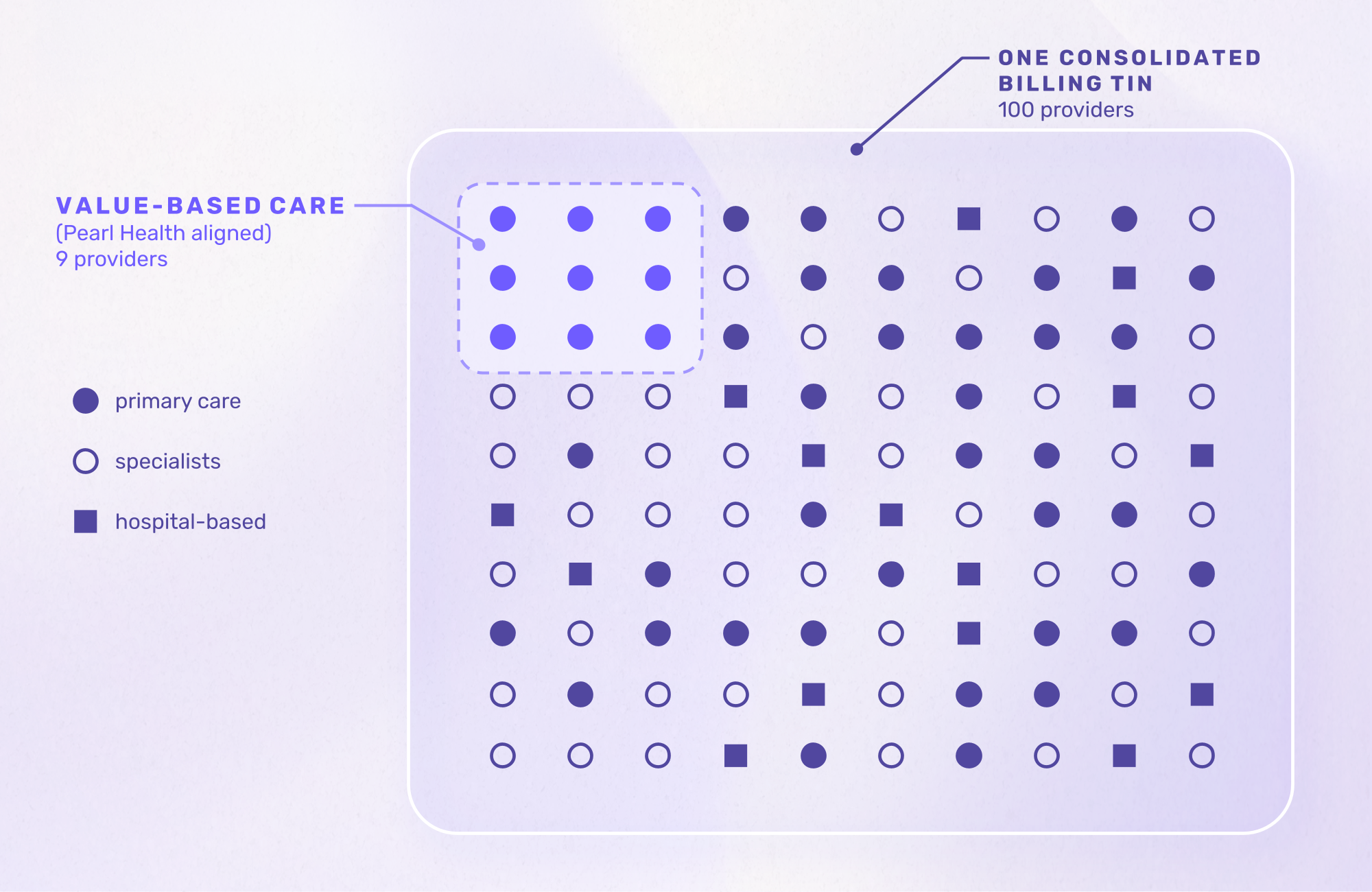
Yet CMS generally requires organizations to enter these accountable-care arrangements through single billing TINs rather than through a defined subset of clinicians or locations within a TIN. In Medicare value-based care, that same structure can precipitate a penalty, by expanding the population with an ACO through CMS’s determination of which clinicians, services, and beneficiaries fall inside its accountability framework.
Many CMS models evaluate performance through patient attribution (or alignment) that is heavily influenced by which clinicians bill under a given TIN. CMS reviews historical billing claims for clinicians within an ACO-enrolled TIN and identifies patients for whom a given clinician has the plurality of certain types of claims. These patients are presumed to have a longitudinal care relationship with their clinicians, facilitating alignment and financial responsibility to the ACO in which the billing TIN is enrolled.
However, while the subset of claims used to identify this pattern were selected to focus on identifying patterns of care that would approximate identification of patient-clinician relationships – and do so in a manner that would justify financial responsibility – this is not a perfect science. If a health system has a large, consolidated TIN with primary care, specialists, hospital-based physicians, and higher-acuity referral patterns all mixed together, many of these clinicians will inadvertently render care that creates the claims patterns that precipitate alignment, without the longitudinal care relationship that justifies putting the clinician at financial risk for that patient’s outcomes.
Consider a beneficiary who has little or no regular primary care utilization during the relevant lookback period but receives several qualifying evaluation-and-management services from a cardiology, pulmonology, nephrology, or oncology practice inside a consolidated health-system TIN. The encounters may be clinically appropriate and relatively concentrated without establishing that the specialist – or the broader health system – is coordinating the beneficiary’s ongoing care.
Depending on the applicable program’s rules and the patient’s other utilization, that claims pattern can contribute to assignment or alignment to the ACO. Clinicians then become financially responsible for the future care and outcomes of a patient they have no ongoing relationship with: you wouldn’t reach out to your heart surgeon months or years after your surgery if you had a general health concern.
This phenomenon can create structural headwinds that have little to do with whether the system is good at managing patients. Financial responsibility for patient cost management in the absence of an active care relationship is an untenable proposition. Such a phenomenon is always a risk of value-based care, as no large-scale application of an algorithm to identify patient-clinician relationships will be perfect. But when a complete TIN that is designed to create market parity in insurance contract negotiations is used to identify longitudinal care relationships, regardless of the specialty of clinicians involved, the alignment mismatch can become predictably larger in magnitude.
The problem isn’t limited to financial risk. Value-based care models can exempt clinicians from the onerous Merit-based Incentive Payment System (MIPS), which requires system-wide reporting of certain measures to CMS. This reporting is of questionable value when an entity is already taking responsibility for the outcomes of its patients in a full financial risk context, with its own program quality measure reporting requirements, which is precisely why such participation can create exemptions.
However, if an entity doesn’t have sufficient volume of care contained to the ACO (i.e., if patients go to other providers outside of the ACO at a high rate), then that entity will fail the relevant tests, and MIPS reporting will remain a requirement despite value-based program participation. Under the current threshold, at least 75 percent of the clinician’s Medicare Part B payments – or 50 percent of the clinician’s Medicare patients – must flow through or be attributed to an Advanced Alternative Payment Model (AAPM).2 Health systems sometimes fail this test for the same reason that makes patient alignment accuracy dubious: when a patient that is assigned to the provider via historical claims does not actually have a longitudinal care relationship with that provider, they are far more likely to receive care elsewhere.
This may seem an esoteric policy idiosyncrasy, but it is often a deciding factor in participation, as organizations take on additional reporting obligations as a result of participating in an ACO. The combination of materially impacted economics and administrative burden can create a chilling effect in value-based program participation and disadvantages health system-affiliated clinicians compared to others.
This matters for national and regional hospital systems alike. These are not unsophisticated actors. They are often organized exactly the way the commercial market encouraged them to organize and how they needed to operate to support lower reimbursement government pay models.
LEAD makes this issue newly urgent. The model begins in 2027 and is intended to offer a 10-year pathway for a broader mix of providers, including organizations serving high-need and specialized populations. Its flexible capitation and Preferred Provider features address several limitations of earlier ACO models. But its core Participant structure still requires whole-TIN participation, and Participant TINs both drive alignment and accept financial accountability.3 LEAD should therefore be viewed not only as an opportunity to expand accountable care, but also as a real-time test of whether CMS can reconcile whole-TIN administration with the structure of integrated health systems.
The problem is that Medicare model design is still too often built around legacy billing architecture, not modern health system reality. As the clinician landscape continues to consolidate, these entities represent an increasingly monumental share of our nation’s clinicians. Encouraging health system participation in value-based care is therefore critical to improving the efficiencies and outcomes of our national health care system.
If we want the best health systems to take more accountability for Medicare outcomes, model architecture has to evolve and allow large systems to design their entry into risk more flexibility or give them strong incentives upfront to make the leap into the deeper end of the pool. Options could include permitting defined TIN/NPI combinations, practice locations, or clinician rosters within a TIN to serve as the accountable participant unit; expanding and simplifying voluntary beneficiary alignment; and further refining which specialists and services can drive claims-based alignment. Otherwise, we will keep confusing billing structure with care management capability.
- Centers for Medicare & Medicaid Services, “Medicare Shared Savings Program: Program Guidance and Specifications”; Centers for Medicare & Medicaid Services, Long-term Enhanced ACO Design (LEAD) Model: Request for Applications (2026).
- Centers for Medicare & Medicaid Services, Quality Payment Program, “What Are Qualifying APM Participants (QPs)?”.
- Centers for Medicare & Medicaid Services, “Long-term Enhanced ACO Design (LEAD) Model”.

Pearl Health is powering the future of healthcare
We’re a team of physicians, technologists, and risk-bearing experts with a passion for enabling our partners to deliver better care and reduce health system costs. Want to learn more?