

The Shared Challenge
Economically, a Medicare Advantage plan is akin to a large Accountable Care Organization. It receives a fixed, risk-adjusted payment to manage the health and cost of a defined population. Its success depends on improving quality, preventing avoidable utilization, and helping patients get the right care at the right time.
Medicare Advantage is now responsible for the care of tens of millions of Americans. CMS projected approximately 34 million Medicare Advantage enrollees in 2026, roughly 48% of the Medicare population.1 At that scale, even modest improvements in clinical execution can have enormous consequences for patients, providers, plans, and the Medicare Trust Funds.
The models pursue that objective through different structures and tools. Medicare Advantage plans can use benefit and network design, member engagement, provider contracting, quality incentives, and utilization management. ACOs generally work through physician alignment, shared clinical information, care-management support, and financial accountability against a total-cost-of-care benchmark. The structural differences are substantial, but both models ultimately depend on changing the clinical decisions that drive outcomes and spending.
Underneath those different toolsets, both models live or die on the same fundamentals: strong physician alignment, accurate population segmentation, early identification of rising-risk patients, care-gap closure, clean transitions of care, and disciplined management of hospital and post-acute utilization.
There is growing evidence that accountable care can produce measurable results.2 In performance year 2024, Medicare Shared Savings Program ACOs generated $2.5 billion in savings for Medicare relative to their program benchmarks. Seventy-five percent of participating ACOs earned performance payments, and ACOs that achieved shared savings recorded lower hospital discharges, emergency department visits, and skilled nursing facility stays relative to their benchmarks.
Where the Models Diverge
MA plans typically carry more machinery and more cost. They design benefits, build networks, administer claims, manage utilization, contract with providers, engage members, and assume insurance and regulatory risk. An ACO, by contrast, generally operates inside traditional Medicare and shares a portion of the savings or losses it produces.
The point is not that an ACO and an MA plan are economically interchangeable. It’s that high-performing ACOs have developed practice-level capabilities that can complement – and potentially improve – the way an MA plan manages its population.
The Missing Layer
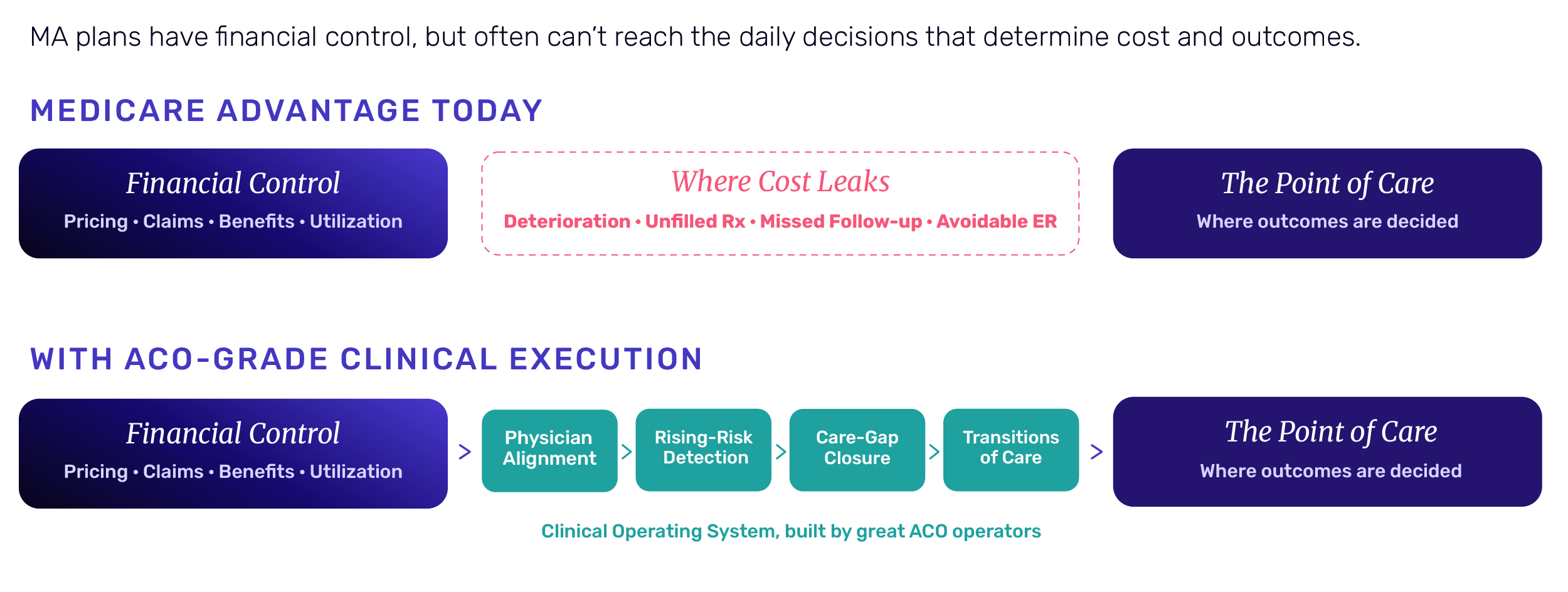
Here's the paradox: Medicare Advantage has largely solved the insurance layer of value-based care before solving the clinical layer. Plans can identify risk, price it, code it, contract for it and manage utilization around it. Far fewer can reliably translate that intelligence into thousands of better clinical decisions inside independent physician practices..
A plan may be excellent at pricing risk, processing claims, configuring benefits, and measuring performance. But the decisive work happens closer to the patient: recognizing deterioration before it becomes an admission, reconciling medications after a transition, ensuring timely follow-up after discharge, closing a high-value care gap, or helping a frail patient obtain support before an emergency department visit becomes necessary.
A clinical operating system closes that gap. It combines timely and longitudinal data, patient-level prioritization, practice-integrated workflows, physician incentives, targeted care-team support, and rapid performance feedback. Its purpose is not to generate another dashboard. Its purpose is to make the next best action clear and feasible for the physician, care team, and patient.
The disconnect between insurance infrastructure and clinical execution contributes to avoidable utilization, missed quality opportunities, unnecessary medical expense, and – most importantly – worse patient outcomes. Closing it is where high-performing ACO operators can create meaningful value.
What Great ACO Operators Bring
The best ACO operators know how to translate data into action inside clinical workflows. They build trusted physician relationships, surface actionable patient opportunities, deploy care teams selectively, align financial incentives, and drive accountability down to the local practice level.
Recent performance data suggest that physician leadership and primary care orientation matter. In the 2024 Shared Savings Program results, low-revenue ACOs – which CMS notes are typically physician-led or composed of federally qualified health centers and rural health clinics – generated $319 in net savings per beneficiary, compared with $180 among high-revenue ACOs, which are typically hospital-led. ACOs composed predominantly of primary care clinicians generated $403 in net savings per beneficiary, compared with $224 among ACOs with fewer primary care clinicians.3
Applied inside Medicare Advantage, those same capabilities can:
- Identify rising-risk patients before an acute event
- Close care gaps through physician-led outreach
- Improve medication adherence and post-discharge follow-up
- Reduce avoidable emergency department, inpatient, and post-acute utilization
- Give practices clearer financial and clinical accountability
- Improve quality, patient experience, and health outcomes
The Path Forward
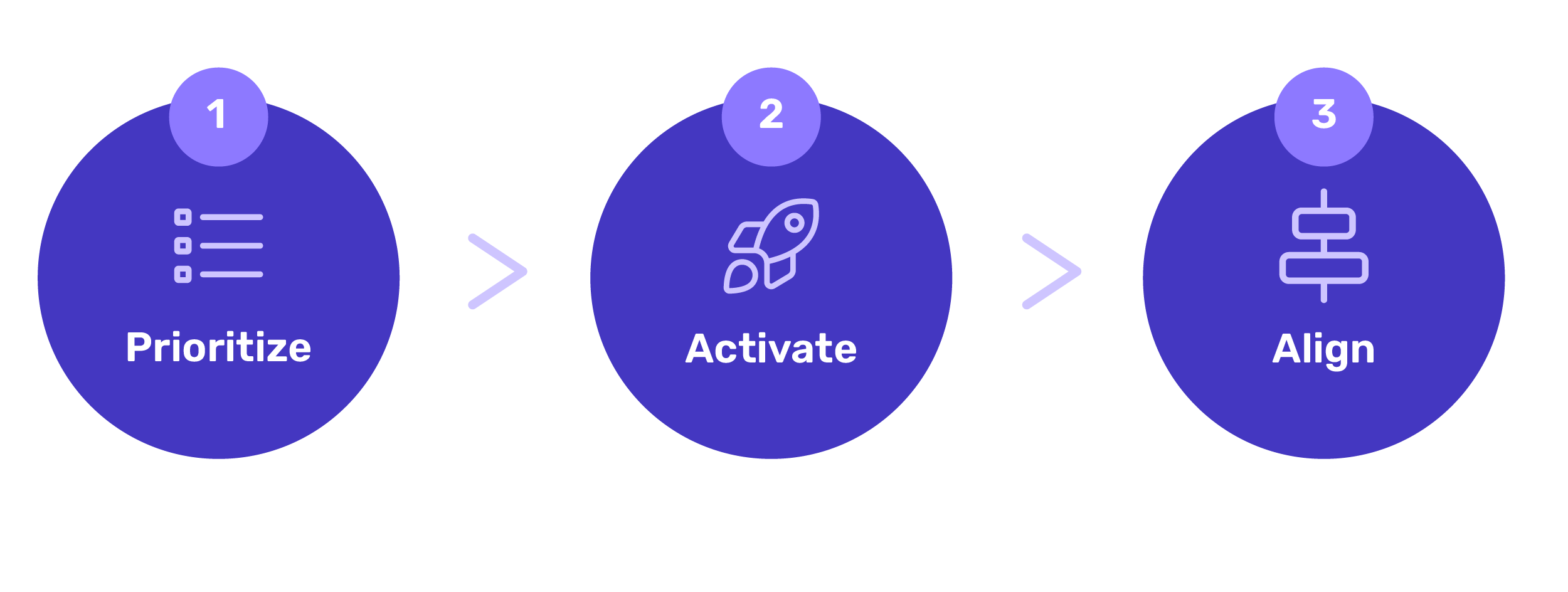
The next generation of successful MA plans will not compete on insurance capabilities alone. They will pair insurer-grade financial discipline with ACO-grade clinical execution. That requires three commitments:
1. Prioritize: Identify the patients, clinical events, and sites of care responsible for the greatest avoidable risk.
2. Activate: Deliver timely, patient-specific actions to physicians and care teams inside their existing workflows.
3. Align: Connect data, care-management resources, incentives, and accountability at the practice level.
The regulatory environment is moving in the same direction. Under CMS’s interoperability rule, affected payers will generally be required beginning in 2027 to provide in-network providers with claims, encounter, clinical, and specified prior-authorization information through a Provider Access API.4 Better data availability will help, but data exchange alone will not create a clinical operating system. Plans will still need the physician relationships, workflows, and accountability necessary to turn that information into action.
Medicare Advantage does not lack data, financial sophistication, or mechanisms for managing risk. The harder challenge is converting those assets into thousands of better clinical decisions made locally and early enough to change outcomes. High-performing ACO operators have spent years building that capability. The MA plans that successfully bring it into the physician workflow will be better positioned to improve the patient experience, reduce avoidable utilization, and create more durable economics.
Medicare Advantage may bear the insurance risk. But clinical execution will determine whether that risk is managed well.
- Centers for Medicare & Medicaid Services. “Medicare Advantage and Medicare Prescription Drug Programs Expected to Remain Stable in 2026.” Press release, September 26, 2025.
- Centers for Medicare & Medicaid Services. “Medicare Shared Savings Program Accountable Care Organizations: Updated Performance Year 2024 Financial and Quality Results.” Fact sheet, September 29, 2025.
- Centers for Medicare & Medicaid Services, “Medicare Shared Savings Program Accountable Care Organizations: Updated Performance Year 2024 Financial and Quality Results,” September 29, 2025.
- Centers for Medicare & Medicaid Services, “CMS Interoperability and Prior Authorization Final Rule (CMS-0057-F),” January 17, 2024.

Pearl Health is powering the future of healthcare
We’re a team of physicians, technologists, and risk-bearing experts with a passion for enabling our partners to deliver better care and reduce health system costs. Want to learn more?
