Medicare's cost curve is on a path that outgrows the tax base built to support it. Whatever policy choices Medicare ultimately makes, the delivery system must produce better outcomes at a lower operating cost.
Value-based care is the right direction, but value-based care alone isn't enough. It only works at the cost structure Medicare actually needs if it's run on technology smart enough to predict problems before they become expensive ones, and lean enough that most of the savings it generates actually reach patient care instead of getting absorbed by a new layer of overhead.
We recently joined Kevin O'Leary on the Health Tech Nerds podcast to discuss Medicare’s affordability challenge – and the operating model we believe value-based care needs to address it.. You can watch the full conversation below.
Medicare's Cost Problem Is Bigger Than Most People Realize
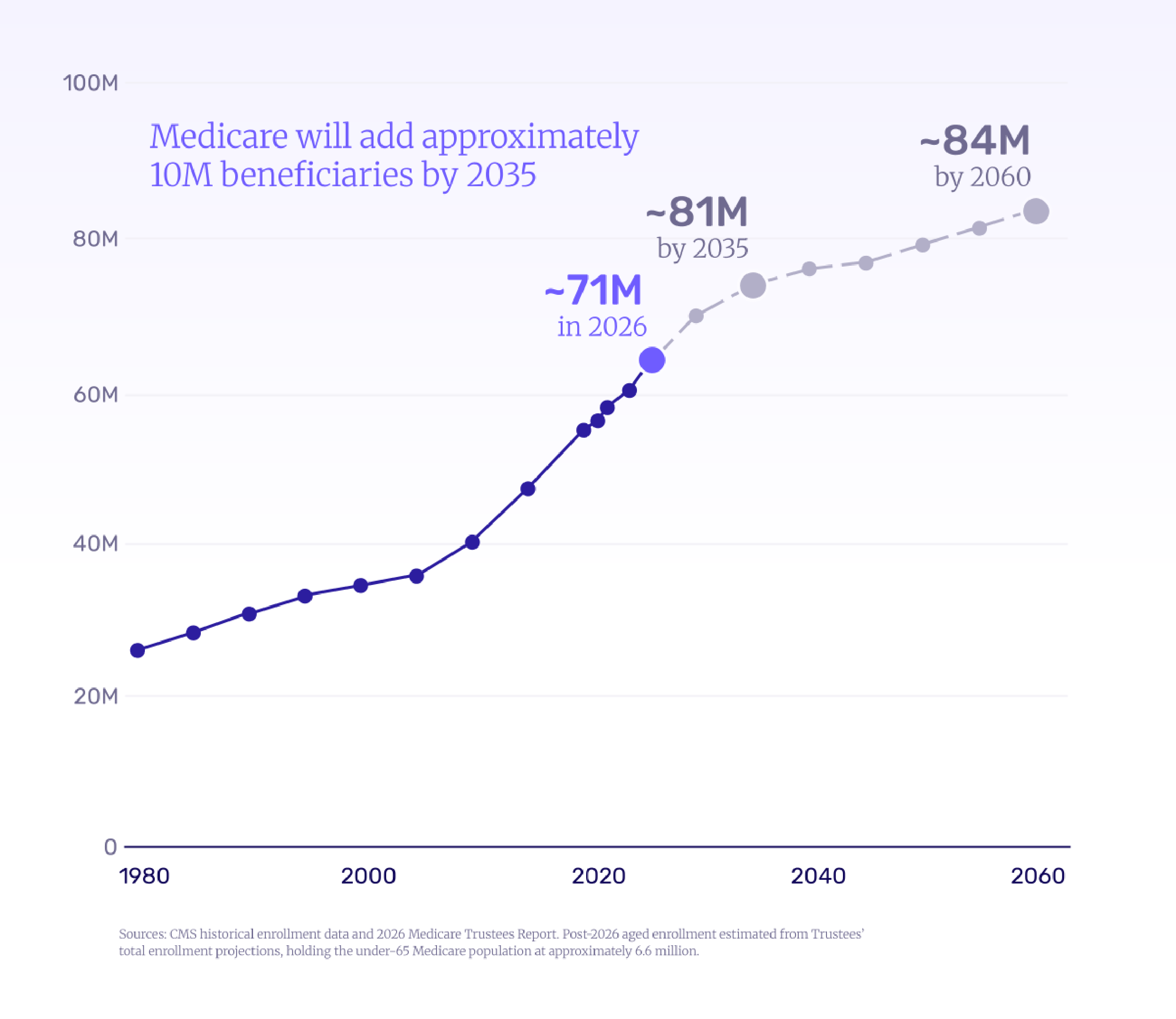
There are seventy million Medicare beneficiaries in the United States today. That number is heading to eighty million within the next decade, and it keeps climbing from there as more people age into Medicare. Even without any changes to eligibility rules, Medicare is on a path toward covering close to a hundred million people.
The program wasn't built for this. When Medicare launched in 1965, and even through the design assumptions that held into the 1980s, the funding model depended on a simple ratio: several workers paying in for every one retiree drawing out. That ratio has collapsed to roughly two workers per retiree, and the math no longer holds up against the pace of cost growth.
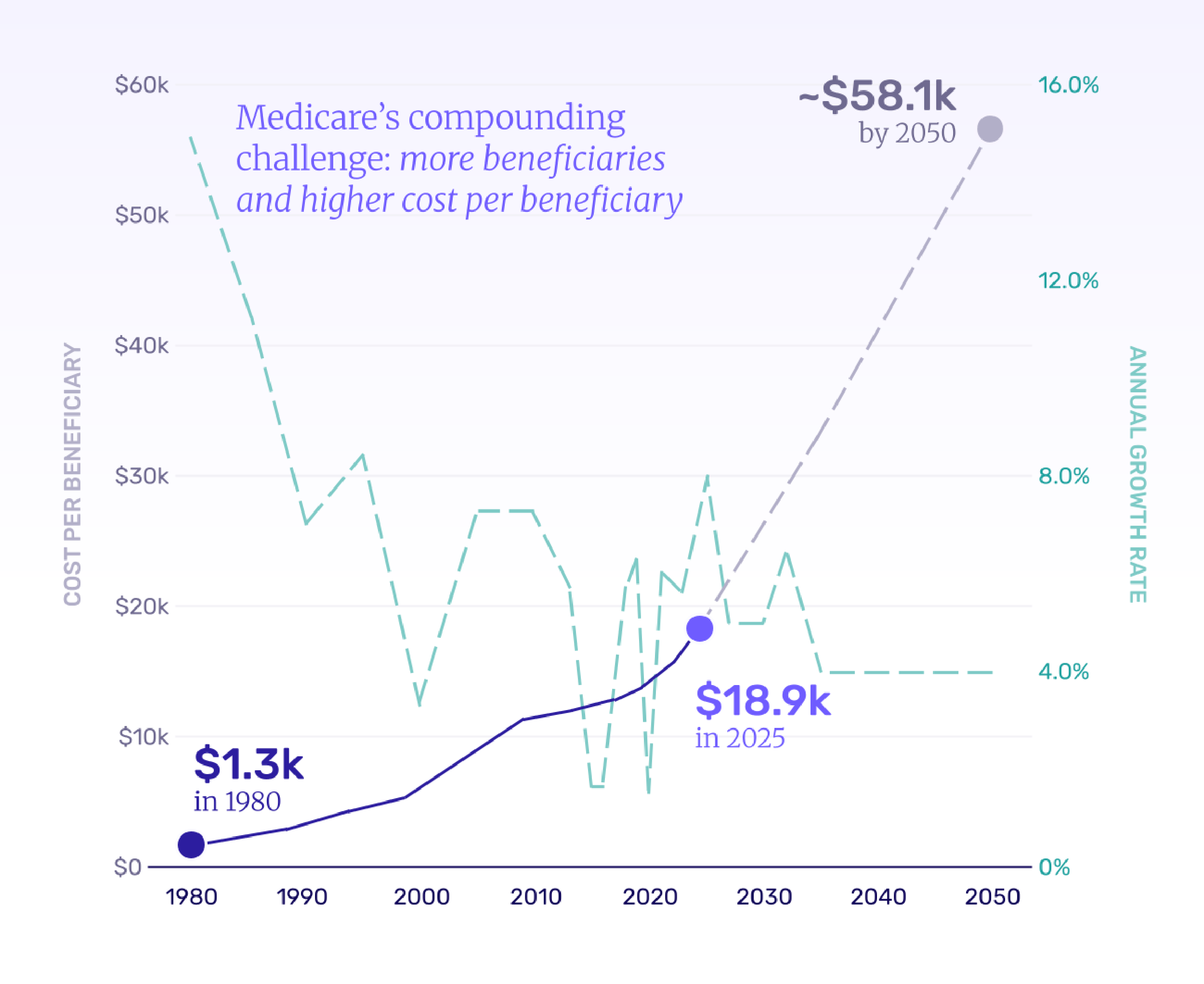
The cost figures make the problem concrete. Average Medicare spending per senior was about $1,300 in 1980. Today it's approximately $18,800, and once you factor in drug costs, we're approaching $20,000 per senior per year. Projections out to 2050, if they hold, show that cost consuming nearly the entire productivity output of an individual worker from a GDP standpoint. The annual growth rate of this spending has outpaced productivity growth since the program began.
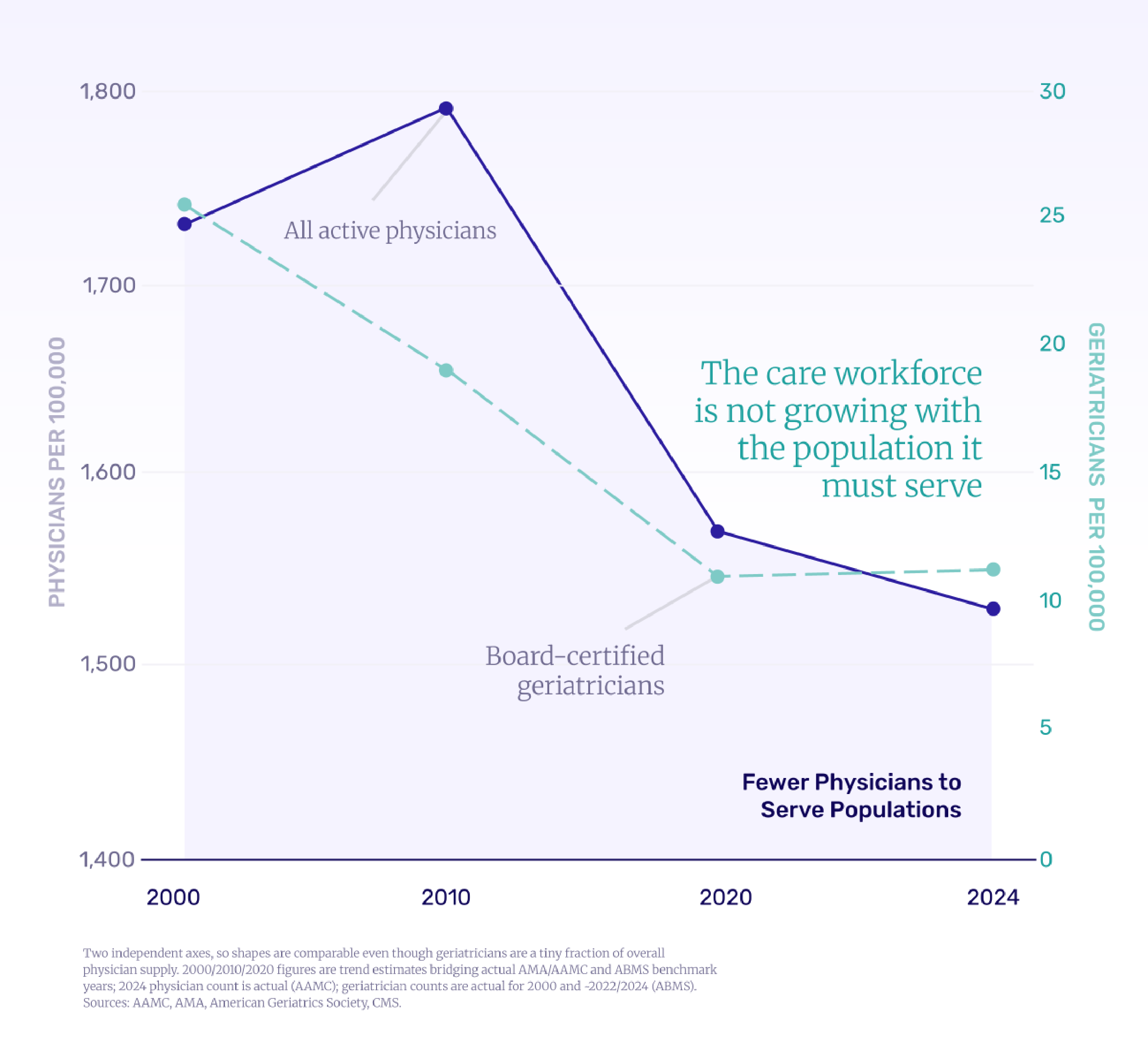
On top of the funding math, the delivery system is strained, and the workforce supporting each beneficiary is shrinking. The primary care physician supply per capita is shrinking. And the shortage is especially stark for the population that needs specialized attention most. There are around seven thousand licensed, practicing geriatricians in the country, which works out to about ten geriatricians for every hundred thousand people. We simply have not built a delivery system that matches what an aging population actually needs.
Raising taxes, cutting benefits, or delaying eligibility age are the traditional levers for addressing a mismatch like this, and none of them are painless. We think there's a better path: change how care is delivered and paid for, so the same or better outcomes cost less to produce. With fewer clinicians available per capita, Medicare cannot meet this challenge simply by adding capacity. It needs a care model that helps existing clinical teams identify risk earlier, intervene more effectively and operate at greater scale.
From a Billing Culture to a Savings Culture
Healthcare in the U.S. was built to generate bills. The system got very good at turning a knee replacement into an $80,000 invoice. That skill made sense when the underlying technology and clinical capability were newer and needed a way to monetize. The challenge now is different. How do you deliver that same care cost-effectively, and how do you keep people healthy and mobile in the first place, since frailty is one of the leading causes of early death in seniors?
Over the past decade, Medicare has made meaningful progress in moving from transaction-based reimbursement toward payment for outcomes. Two-sided risk grew from virtually zero to roughly two-thirds of MSSP ACOs, while savings per beneficiary increased approximately twelvefold.
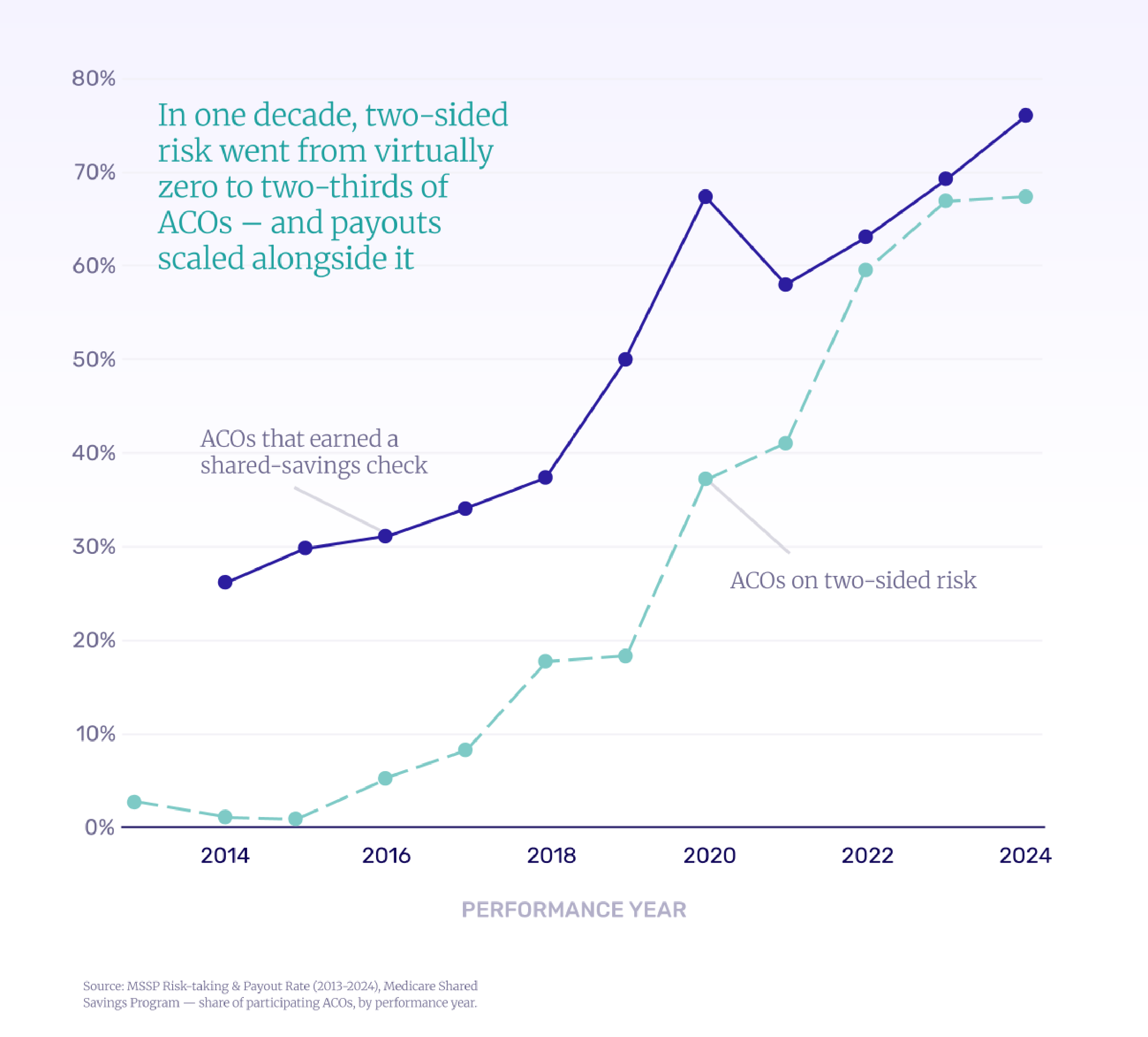
But participation does not guarantee performance. Roughly four in ten MSSP ACOs remain below the 3% savings rate associated with underwriting breakeven. REACH has generated greater average savings, but with approximately twice the dispersion. Payment design creates the opportunity; operating execution determines the result.
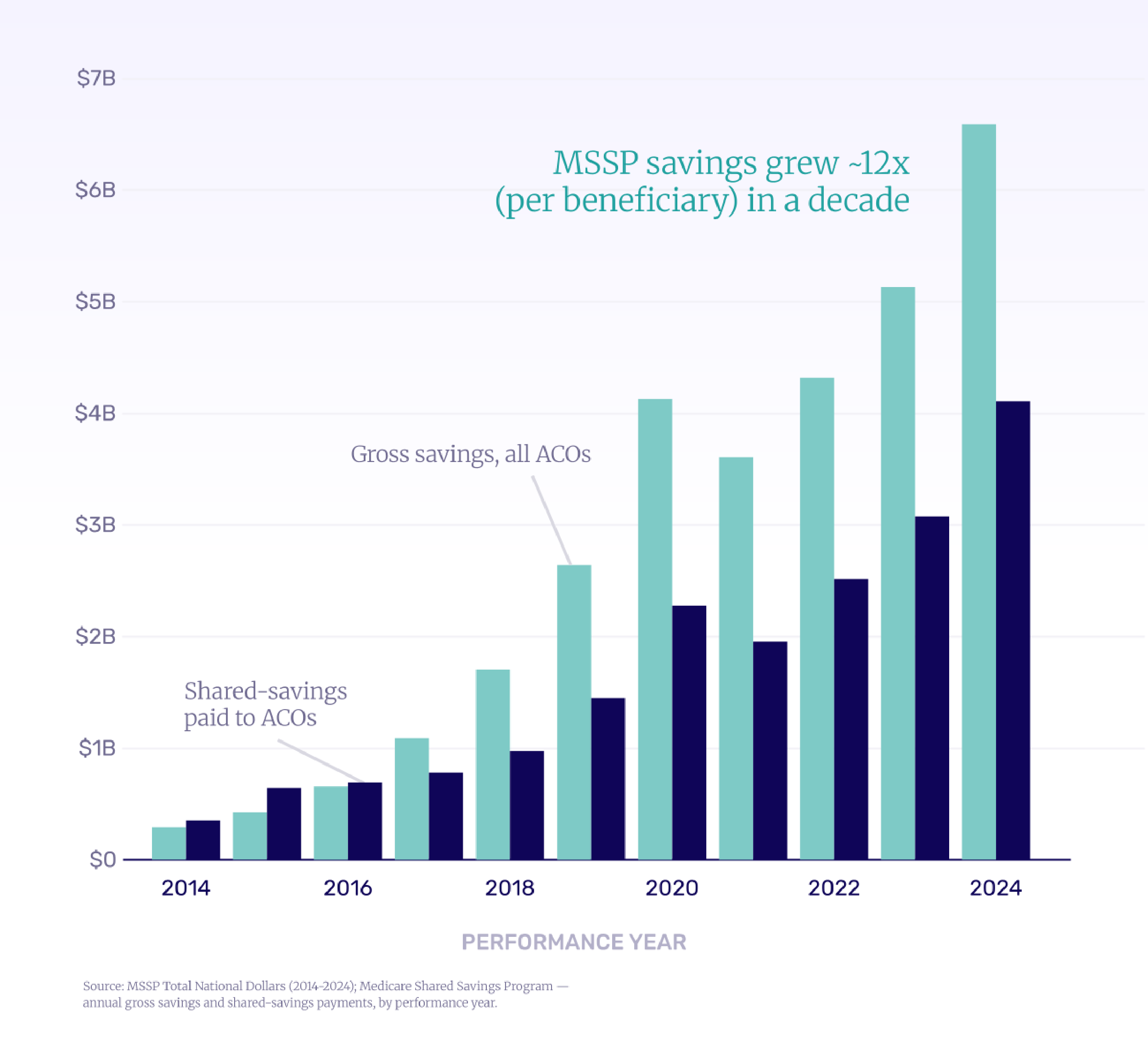
Newer models like ACO REACH and LEAD matter because they bring in more participants and test new payment structures. There will be setbacks along the way (LEAD, in particular, will likely see fewer entrants than REACH did before it settles in), but each iteration previews a system where clinical expertise and societal cost outcomes move in the same direction instead of pulling apart.
But shifting the payment model only gets you so far. A provider group that takes on risk without the technology to manage it well just inherits the downside without the tools to avoid it. That's the piece we think is underappreciated: the payment model and the technology underneath it have to improve together, or the savings this category promises don't actually show up.
Turning Fragmented Data into Prioritized Clinical Action
We started Pearl on a simple premise: connect data with predictive technology so you know what's likely to happen to a senior before it happens, then make sure a physician and their team are present at the moments that matter most. An avoidable hospitalization. An avoidable ER visit. A missed medication. A wellness visit that never got scheduled. These are the events that, in a fee-for-service world, mostly go uncompensated even though addressing them is exactly what good care looks like.
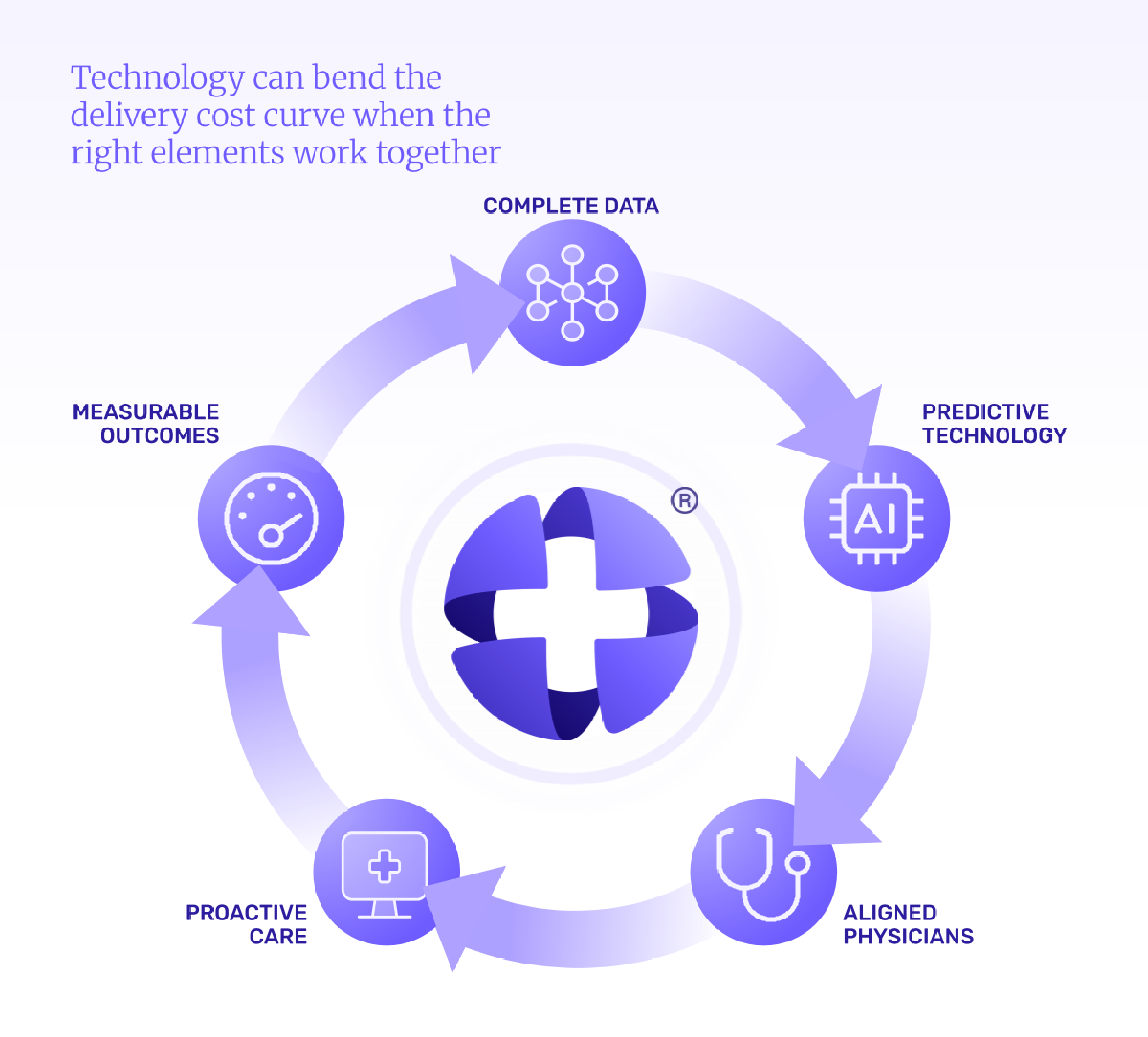
We integrate a wide range of data, claims feeds, ADT alerts, EHR connections, Medicare Advantage plan data, and run it through a predictive model that tells our clients what's most likely to happen next. This matters because healthcare spending is concentrated: roughly five to ten percent of the Medicare population accounts for something like half of all healthcare spending. Rather than treating everyone the same, we focus the system on identifying that high-risk group early and intervening before costs escalate.
Today we're tracking 166 distinct patient-level data points, and that number keeps growing as we connect into more EHRs and social determinants of health data. Pearl’s models identify a top 5% cohort that accounts for 22.7% of next-quarter spending and have demonstrated 12 percentage points greater precision than incumbent models. These signals allow care teams to focus their constrained clinical capacity where earlier intervention can have the greatest impact.
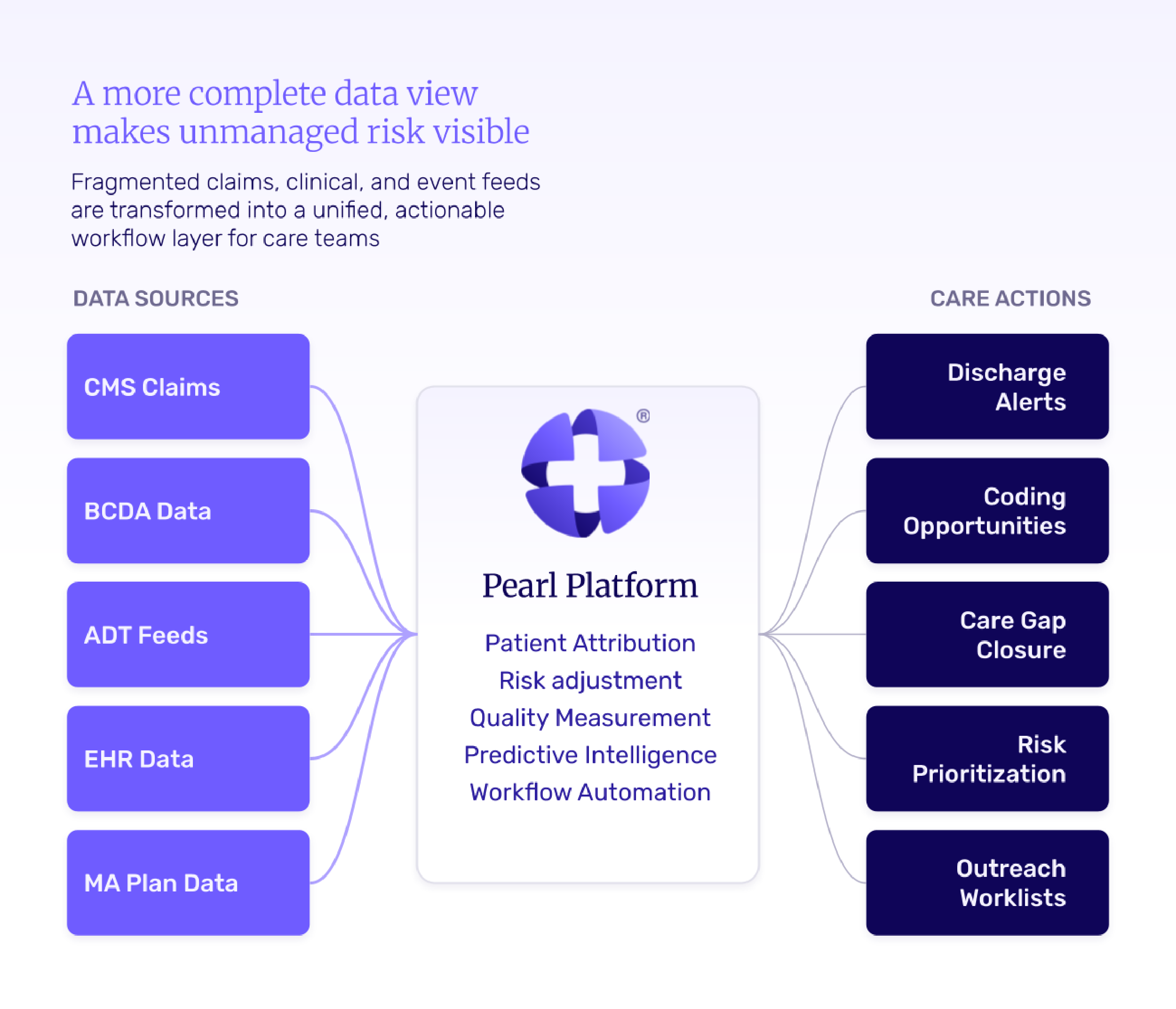
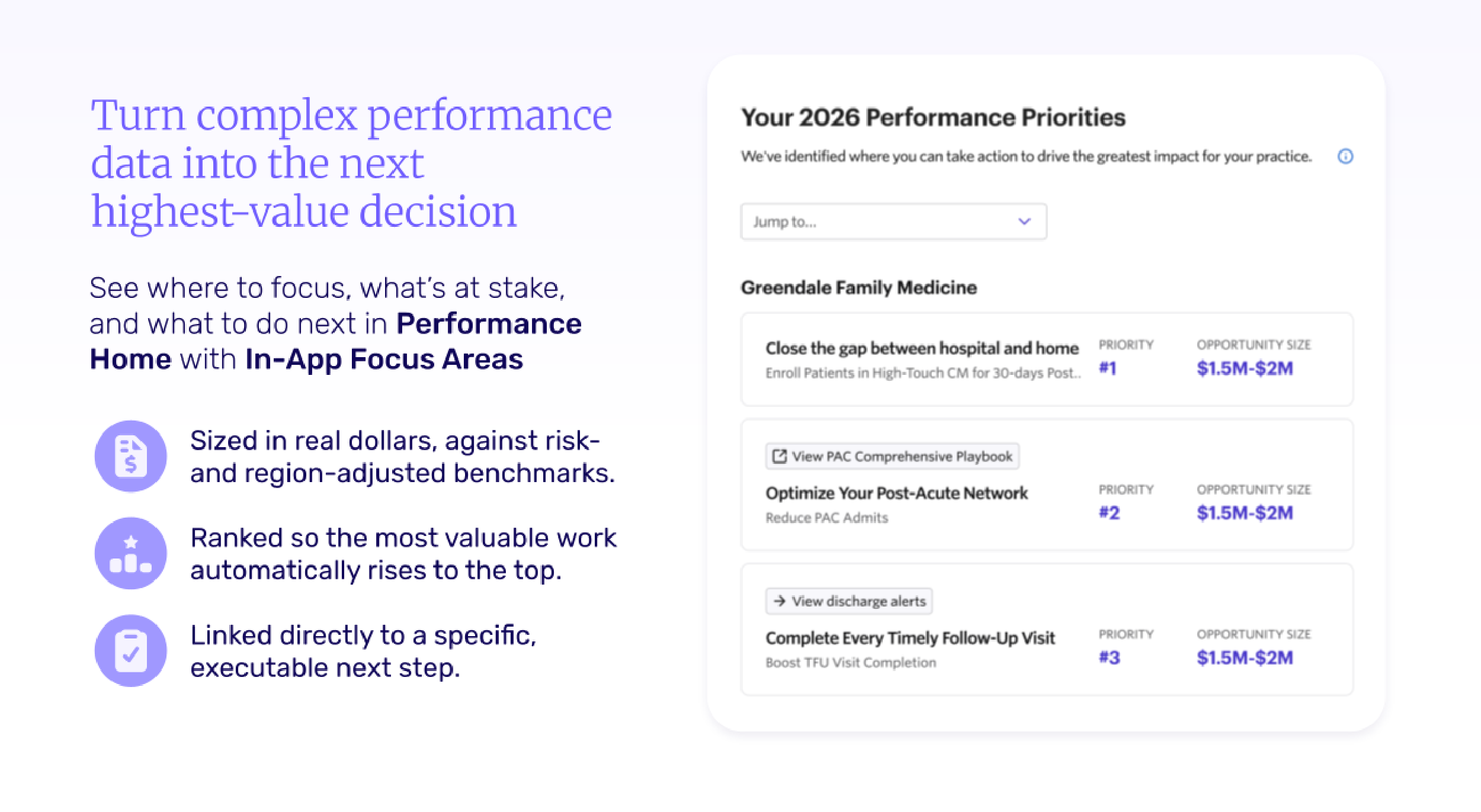
The core design principles behind the platform are actionability, simplicity, and a clear framework connecting a signal to a recommended action. Underneath all of that is what we call the urgency score: a single number that tells a care team who to reach out to right now, factoring in cost risk, quality outcomes, and the specific rules of whatever payment program a given patient falls under.
In practice, this shows up to clients as a simple color code: red means do now, pink means do next, blue means something to be aware of. Simple constructs like that are what actually change behavior in a clinic day-to-day, especially when they're paired with incentives, like higher shared savings advances tied to completing more "do now" actions each month. The output is an explainable, prioritized work queue, not another library of static dashboards. Care teams can see the signal, understand the relevant clinical context and act before avoidable cost escalates.
Prediction and Automation Change the Delivery Economics
AI is valuable in this context only to the extent that it changes operating performance. Predictive models help identify rising risk earlier. Workflow automation handles routine tasks such as follow-up scheduling and care-management outreach. Conversational analytics help clinical and operating leaders move from retrospective reports to the next highest-value decision.
The objective is not to remove clinicians from care. It is to focus limited clinical capacity on the patients and moments where human intervention can have the greatest impact.
What the Results Look Like
None of this matters if it doesn't show up in outcomes. So, here's where we are.
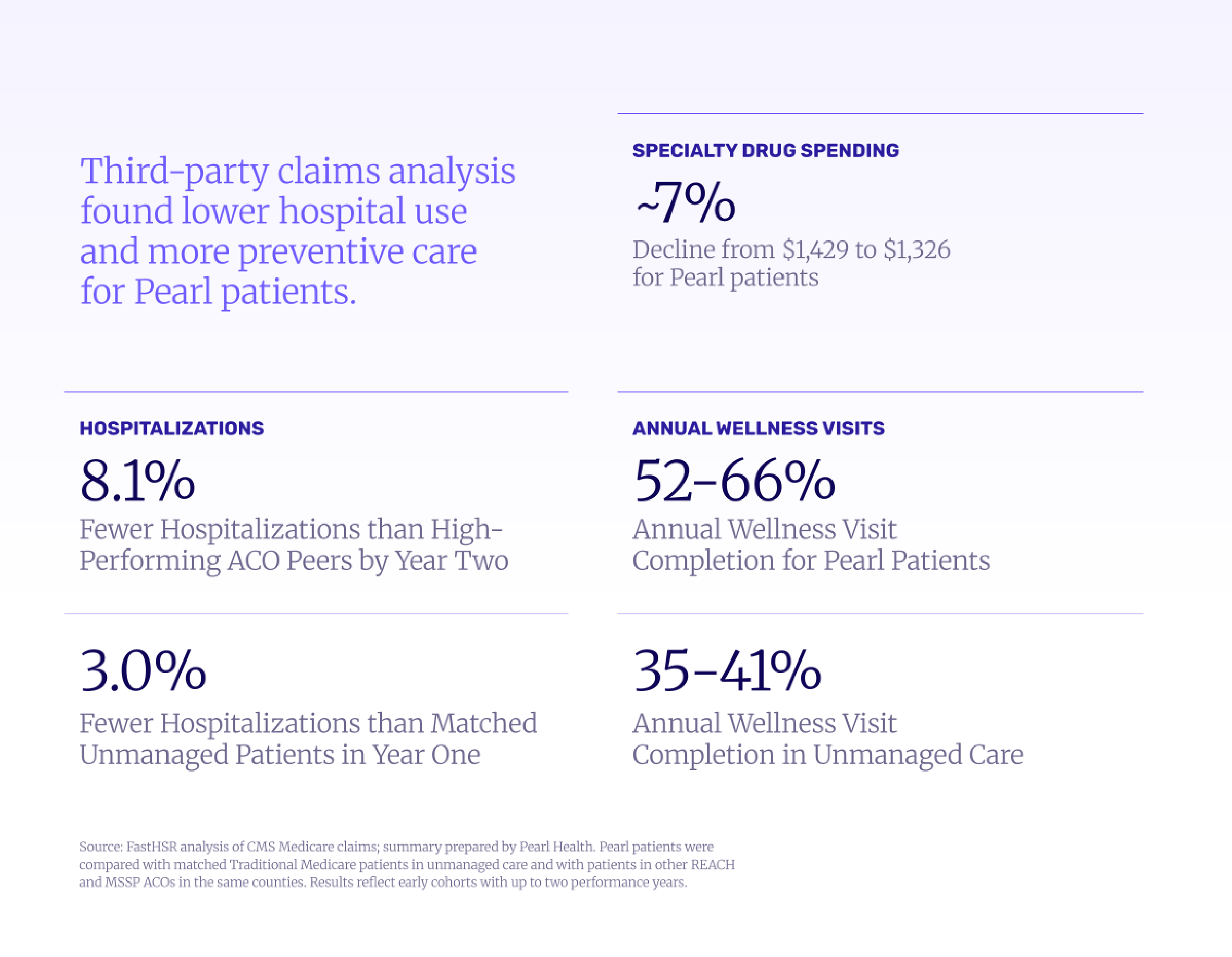
Patients with Pearl for one to two years show an 8.1 percent reduction in avoidable acute utilization, and we see improvement across other markers too, including annual wellness visit completion and advance care planning.
These effects compound: the longer a patient is in the program, the more the numbers move. Notably, in a period where specialty drug spending has been rising across the broader Medicare population, we saw a statistically significant decline in that spend among Pearl patients, and this held up under third-party review, not just our own analysis. We operate across forty-three states now, closing in on half a million lives managed, which means our results are increasingly reflective of Medicare trends more broadly. These findings reflect early cohorts with up to two performance years.
The Administrative Ratio Is the Key to Sustainability & Affordability
Scalable outcomes also require scalable economics. Here's a number we think doesn't get enough attention: administrative ratio. Administrative ratio is defined as total operating expenses divided by total benchmark managed. It represents overhead.
A typical health insurer runs around 12 percent. Other value-based care enablers we've been able to benchmark run closer to 6 percent. In contrast, Pearl’s admin ratio runs below 1.3 percent today, and we expect that to fall further as we scale, since the cost to support a larger network of managed lives grows much more slowly than the network itself.
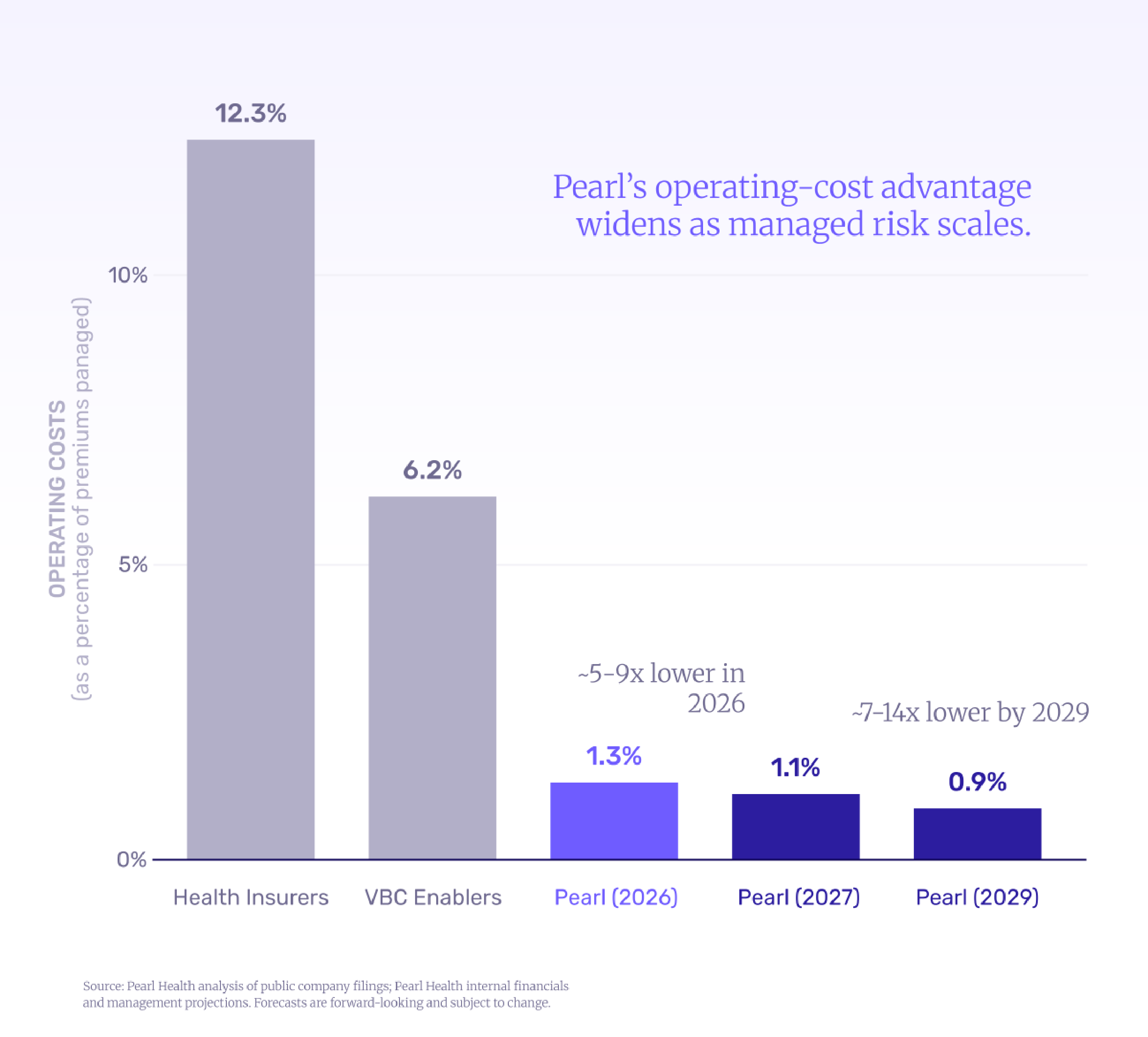
This is the part of the story that separates a good idea from a workable one. Value-based care shifts the incentive in the right direction, but if the technology behind it isn't good enough to predict who needs attention and automate the routine work of getting it to them, the model ends up needing an expensive staff-model apparatus to make up the difference. That's a large part of why some enablers in this category have struggled: they took on the right kind of risk with a cost structure that couldn't sustain it. A model that runs on prediction and automation instead of headcount is what makes the low administrative ratio possible in the first place, and the low ratio is what makes the rest of the savings available to actually reinvest in care.
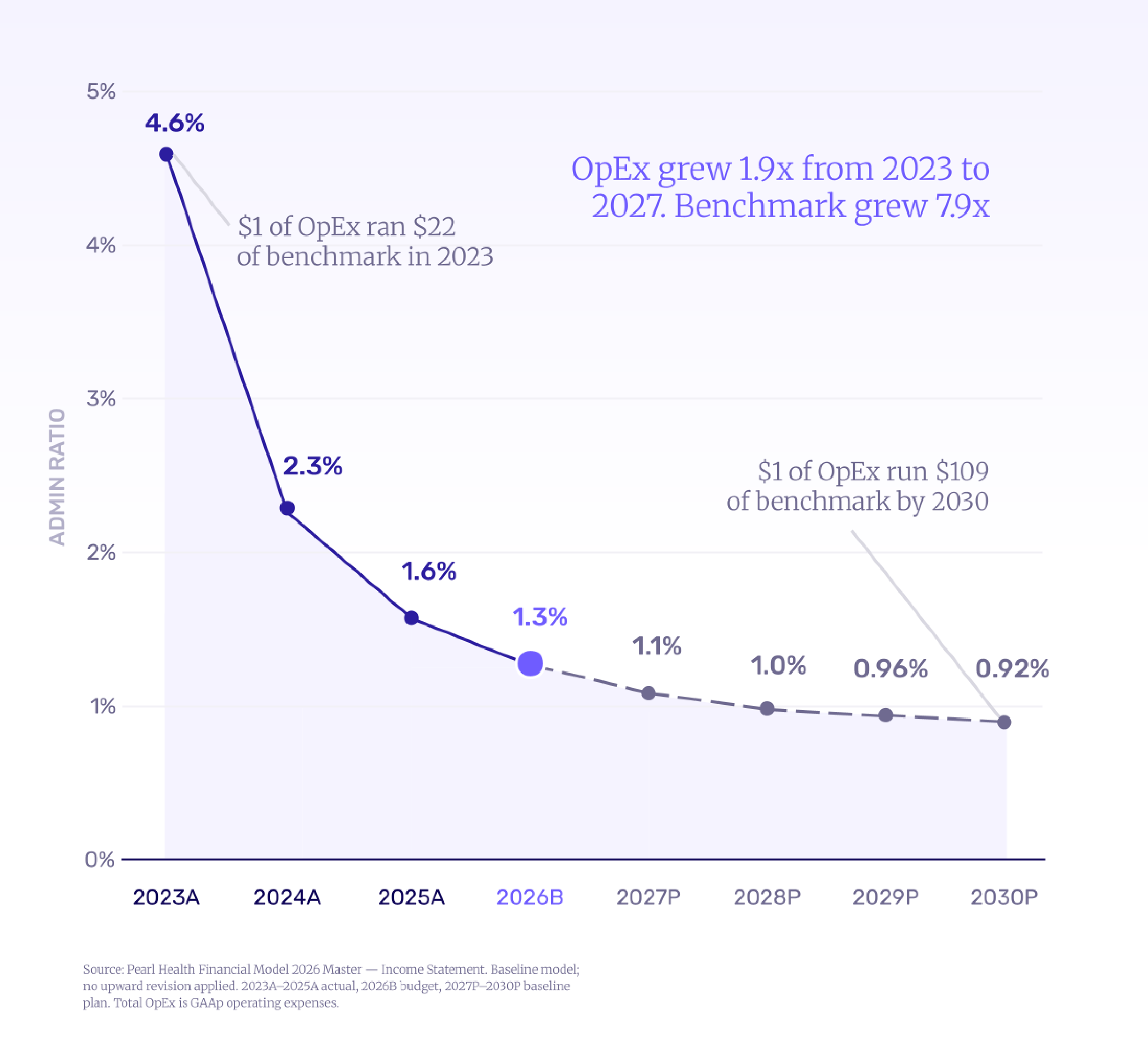
Why does this matter so much? Because every percentage point that goes to an administrative layer is a percentage point that isn't going toward actual patient care. If a provider group can manage risk and manage outcomes well, there's a real question worth asking: why should twelve to fifteen cents of every dollar go to an insurance layer instead of one or two cents going to enablement and the rest going directly to the people delivering care? We'd point to what happened in the mutual fund industry in the '80s and '90s as a useful parallel. Fees used to be where the money was made. Then the market corrected, and the return profile for investors changed for the better. We think healthcare administrative costs are due for the same correction, and a technology-first model without a physical staffing footprint is how we've kept our own ratio low while still growing quickly.
Where This Goes From Here
The next phase of value-based care is not simply about moving more providers into downside risk. It is about helping more organizations succeed once they are there. That requires three capabilities working together: aligned payment incentives, actionable clinical technology and an operating model that scales efficiently.
We don't think two-sided risk needs to be forced onto every provider through policy. Markets tend to price this in on their own: groups willing to take on downside risk generally capture more of the upside, and groups that avoid it capture less. The more interesting question, in our view, isn't how downside risk gets distributed. It's how you get more of Medicare into ACO-style payment models in the first place. Roughly fifteen million lives are in an ACO today. If that number moved toward thirty million, at an average savings rate of three to four percent, that's where the real cost reduction in the system comes from. We're at five to six percent savings today, targeting eight percent next year and ten percent by 2029.
MSSP is stable and isn't going anywhere. ACO REACH is transitioning into LEAD, which we expect to see a smaller initial cohort than REACH had, mainly because its new and large groups take time to get comfortable with new program structures. We expect that hesitation to ease over the next year or two, and we think LEAD's ten-year runtime, rather than the shorter cycles of past CMMI models, will build the kind of trust that gets more organizations to commit.
We're staying focused on Medicare for now. Even with the scale we've reached, we're only a small fraction of total ACO lives and an even smaller fraction of Medicare overall. There's a lot more room to grow here before adjacent markets make sense for us.
The Test for Scalable Value-Based Care
For healthcare leaders evaluating value-based care models, the relevant questions are practical: Are clinical outcomes independently measured? Does technology change what care teams do each day? And can the operating model scale without adding cost at the same rate as managed lives?
We believe those are the tests that will determine whether value-based care can deliver on its promise: better outcomes for a growing Medicare population at a cost the system can sustain. Our full conversation with Health Tech Nerds explores these ideas in greater detail.

Pearl Health is powering the future of healthcare
We’re a team of physicians, technologists, and risk-bearing experts with a passion for enabling our partners to deliver better care and reduce health system costs. Want to learn more?