For much of the past two decades, healthcare leaders have operated under a common assumption: better outcomes require better data.
The industry’s investments have reflected that belief. Health systems have spent billions implementing electronic health records, integrating clinical and claims data, building analytics infrastructure, and pursuing interoperability. Payers have invested heavily in predictive modeling, risk stratification, utilization management, and increasingly sophisticated data platforms. More recently, healthcare organizations have begun layering artificial intelligence onto an already substantial digital foundation.
These investments have delivered real progress. Compared to where the industry stood fifteen years ago, healthcare organizations today possess dramatically greater visibility into patients, populations, utilization patterns, clinical performance, and financial outcomes.
Yet despite this expansion in information, many of healthcare’s most persistent challenges remain unresolved. Chronic disease management remains inconsistent, preventable hospitalizations continue to occur, and healthcare spending continues to rise faster than outcomes. Significant variation in quality and performance persists across organizations caring for similar populations.
At the same time, clinicians report growing administrative burden and cognitive overload. Research published in Mayo Clinic Proceedings found that physicians spend approximately 24% of their working hours on administrative activities, and nearly two-thirds report that those burdens negatively affect their ability to deliver high-quality care. Relatedly, burnout remains a significant challenge. According to the American Medical Association’s most recent national survey, approximately 42% of physicians reported at least one symptom of burnout in 2025.
The disconnect suggests that healthcare’s primary constraint may no longer be what many leaders assume it to be. The industry still faces important challenges related to data quality, interoperability, and fragmentation. Those challenges have not disappeared. Increasingly, however, they are not the primary constraint on performance. The greater challenge is determining how to transform an overwhelming volume of available information into timely, coordinated, and effective action.
Healthcare does not fundamentally have a data problem anymore. It has a decision problem.
From Data to Orchestration
Historically, healthcare’s focus on data was entirely rational. Clinical information was fragmented across paper records, disconnected systems, and organizational silos. Physicians often lacked access to complete patient histories, and critical decisions were routinely made with incomplete information. In that environment, improving information availability represented one of healthcare’s greatest opportunities, making investments in electronic health records, interoperability, analytics, and data aggregation both necessary and overdue.
The transformation has been substantial. As of 2021, 96% of U.S. non-federal acute care hospitals had adopted certified electronic health records, and by 2023, 70% engaged in all four domains of interoperable exchange: sending, finding, receiving, and integrating patient information. Increasingly, healthcare’s challenge is not whether information exists, but whether organizations can effectively act on it
Healthcare’s evolution over the past three decades can be understood through a series of changing constraints:
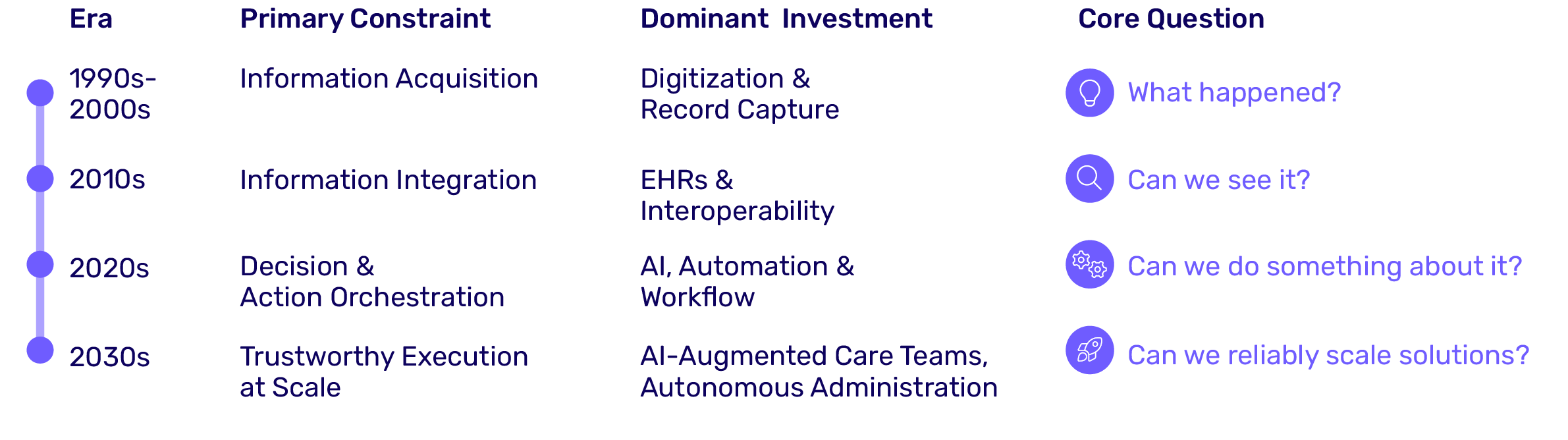
Healthcare has become increasingly effective at generating signals. It remains far less effective at coordinating the decisions and actions those signals should trigger. The challenge may be less one of decision-making than orchestration.
Consider a Medicare beneficiary with diabetes, hypertension, congestive heart failure, and a recent hospitalization. A primary care physician knows the patient missed a follow-up appointment. A specialist recently adjusted medications. A hospital discharge team recommended additional monitoring. A pharmacy sees that a prescription was never filled.
None of these participants lack information; none are necessarily making poor decisions. Yet the patient still ends up in the emergency department. The failure occurs not because the healthcare system lacked insight, but because it failed to coordinate action.
Healthcare increasingly resembles an orchestra more than a database. The industry has spent decades ensuring that every musician has access to the sheet music. Yet possessing talented musicians and complete sheet music is not the same as producing a symphony. The challenge is ensuring that dozens of participants act in concert.
Viewed through this lens, many of healthcare’s most persistent challenges begin to look less like data problems and more like orchestration failures. In many cases, healthcare organizations already know what should happen. The care gap has been identified, the discharge notification received, the rising-risk patient flagged, and the referral recommended.
The decision, at least conceptually, has already been made. What’s missing is coordinated execution. This is why simply adding more data rarely produces proportional improvements in outcomes. Once an organization reaches a certain threshold of visibility, performance depends less on information and more on its ability to orchestrate action. The organizations that outperform in the coming decade will not necessarily be those with access to more data. They will be those that become better at coordinating decisions and actions across increasingly complex care environments.
When Insight Doesn’t Become Impact
One of healthcare’s most persistent misconceptions is the belief that insight creation and value creation are synonymous. Healthcare organizations increasingly excel at identifying opportunities. Predictive models identify rising-risk patients, analytics platforms surface care gaps, AI systems generate recommendations, and dashboards provide unprecedented visibility into performance.
These capabilities are valuable, but they are not outcomes. A model that predicts a hospitalization does not prevent one, nor does a dashboard close a care gap. Value is created only when information changes behavior and ultimately changes outcomes.
This distinction is particularly important in value-based care. Although gaps remain, many organizations can identify rising-risk patients, forecast future utilization, and measure performance with increasing precision. Far fewer have developed reliable systems for ensuring that the appropriate intervention occurs at the appropriate moment for the appropriate patient. The challenge is no longer prediction; the challenge is orchestration.
The Cost of Too Much Information
The conventional assumption is that more information naturally leads to better decisions. In practice, decades of research in psychology, behavioral economics, and organizational design suggest a more complicated reality. As the volume of available information increases, decision-making often becomes slower, less confident, and less effective. Beyond a certain threshold, additional information can create diminishing returns and, in some circumstances, actively impair performance.
Healthcare is increasingly encountering this phenomenon at scale. Every dashboard, quality measure, alert, and recommendation competes for attention. Collectively, these tools can create an environment in which clinically meaningful signals become lost among competing priorities.
The consequences are visible. Care teams frequently struggle to determine which opportunities deserve immediate attention and which can wait. Critical interventions are missed not because information was unavailable, but because the signal was buried among dozens of others demanding attention. In an environment where information is abundant, prioritization becomes more valuable than information itself.
Built for a Different Era
Perhaps the deeper issue is that many of healthcare’s operating models were designed for a world that no longer exists. Much of healthcare’s infrastructure evolved during a period when information moved relatively slowly and clinical decision-making occurred primarily during episodic encounters. Staffing models, workflows, reimbursement structures, and technology systems were built for that reality.
Electronic health records were designed to document care, facilitate billing, and maintain longitudinal records, not to determine which patient requires intervention today. Similarly, many reporting and quality measurement frameworks were designed to explain what happened rather than drive what should happen next.
As a result, organizations frequently layer new analytics and AI capabilities onto operating models that were never designed to process information at modern scale, creating increasing informational sophistication without a corresponding increase in effectiveness.
The Rise of Orchestration-Centric Healthcare
The organizations best positioned for the future are approaching the problem differently. Rather than beginning with data, they begin with workflows.
They ask which decisions must be made, which actions those decisions should trigger, who is responsible for those actions, and how those actions should be coordinated across participants. Only then do they determine how technology, analytics, and workflows should be structured. This may sound like a subtle distinction, but it fundamentally changes how organizations operate.
Orchestration-centric organizations focus less on generating additional information and more on reducing friction between information and action. They invest in prioritization, workflow orchestration, automation, and operational design. Their goal is not simply to understand their populations better. Their goal is to intervene more effectively. In this model, technology serves as an operational layer rather than merely an analytical one. The objective is not to create more visibility. It’s to create more coordinated action.
The Next Healthcare Advantage
Healthcare spent the last two decades building systems capable of capturing information. The next decade will belong to organizations capable of orchestrating action. As artificial intelligence makes insight generation increasingly abundant, the differentiator will not be who knows the most. It will be who can most consistently translate knowledge into intervention.
Healthcare has made remarkable progress solving the problem of information scarcity. The harder challenge now lies ahead: building institutions capable of acting on what they already know. The organizations that solve that challenge will create disproportionate value — not because they possess more information, but because they are better at orchestrating action and turning it into outcomes.
- Sinsky CA, Brown RL, Stillman MJ, Linzer M. Allocation of Physician Time in Ambulatory Practice: A Time and Motion Study in 4 Specialties. Annals of Internal Medicine. 2016;165(11):753–760. doi:10.7326/M16-0961. Available at: https://pmc.ncbi.nlm.nih.gov/articles/PMC7661623/
- American Medical Association. Physician burnout rate continues decline, falling to nearly 42%. AMA News. Published April 2026. Accessed June 2026. Available at: https://www.ama-assn.org/practice-management/physician-health/physician-burnout-rate-continues-decline-falling-nearly-42
- Office of the National Coordinator for Health Information Technology. National Trends in Hospital and Physician Adoption of Electronic Health Records. HealthIT.gov. Accessed June 2026. Available at: https://www.healthit.gov/data/quickstats/national-trends-hospital-and-physician-adoption-electronic-health-records/
- Office of the National Coordinator for Health Information Technology. Interoperable Exchange of Patient Health Information Among U.S. Hospitals, 2023. HealthIT.gov. Accessed June 2026. Available at: https://www.healthit.gov/data/data-briefs/interoperable-exchange-patient-health-information-among-us-hospit

Pearl Health is powering the future of healthcare
We’re a team of physicians, technologists, and risk-bearing experts with a passion for enabling our partners to deliver better care and reduce health system costs. Want to learn more?