

The August 1st CMS enrollment deadline is less than 60 days away, and the decisions you make in the coming weeks will shape your organization's performance trajectory for the year ahead.
Many primary care and ACO leaders are navigating challenging realities: ongoing losses with no clear path to shared savings, mounting operational complexity, or strategic questions about whether maintaining current arrangements remains viable.
Last week, we hosted a webinar examining how successful organizations are approaching these challenges. Drawing from insights from risk-bearing partnerships with more than 3,500 primary care providers nationwide, the session explored data-driven strategies that have helped organizations increase their Traditional Medicare revenue potential from shared savings by as much as 70%.
Here are three critical areas that every primary care and ACO leader should evaluate before the CMS deadline on August 1st.
3 Critical Considerations
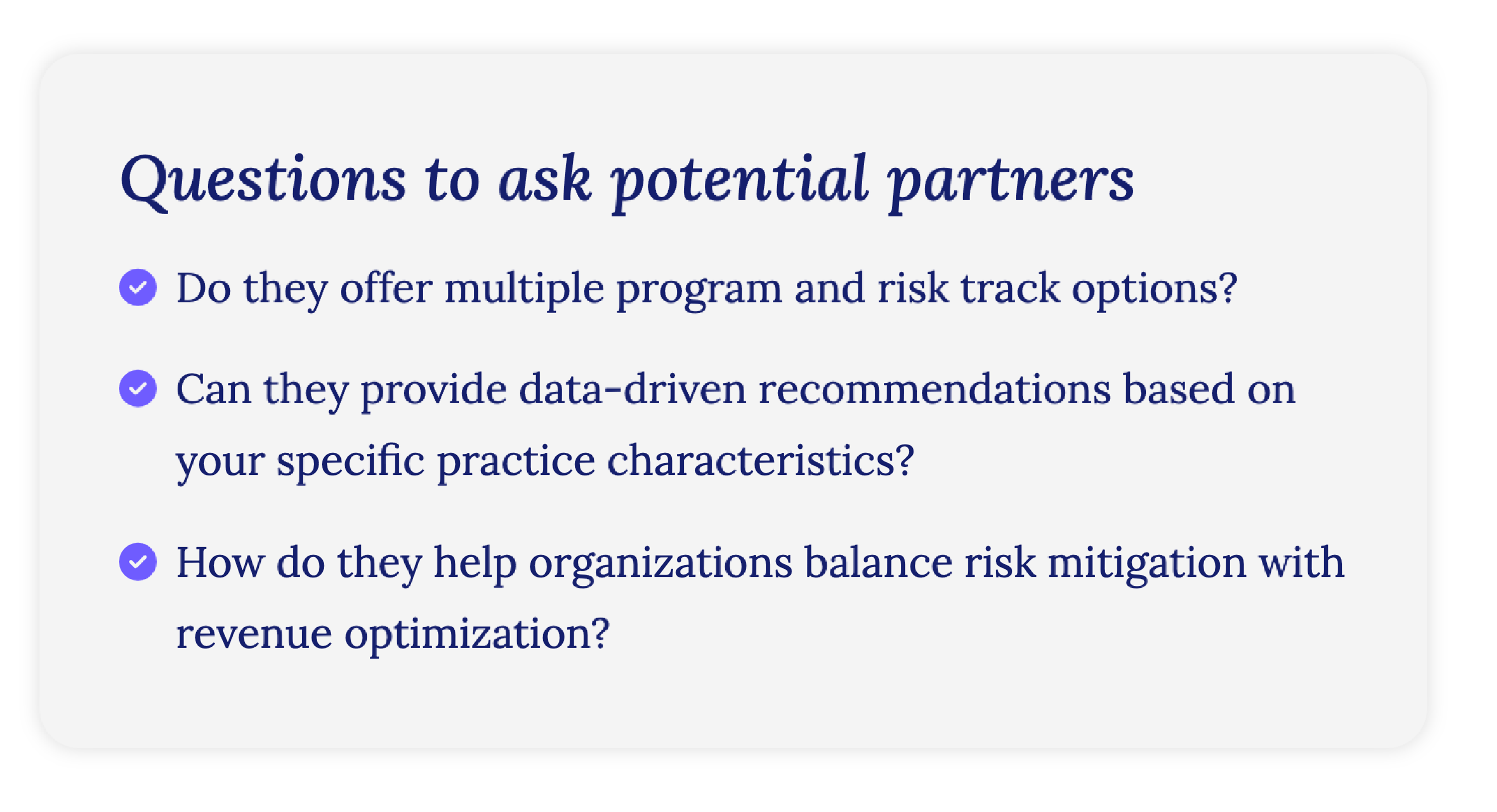
1. Risk Optimization: Are you participating in the right mix of value-based care programs, models, and risk tracks?
Many organizations enroll all primary care providers to a single program and risk track. This approach limits optimization opportunities and can leave revenue on the table.
What successful organizations do differently: Leading ACOs treat risk participation like portfolio management, recognizing that different practices within their organization may be suited for different risk tracks and payment models.
Beyond basic financial forecasting: The most sophisticated organizations analyze multiple factors to predict value-based care success:
- Panel characteristics: RAF improvement rates and service utilization patterns
- Practice stability: Beneficiary retention rates and operational consistency
- Care delivery patterns: Identifying optimization opportunities in current workflows
- Organizational readiness: Historical performance and risk management experience
Our alliance with Pearl Health will enhance the knowledge and capabilities of our primary care providers, enabling them to adopt a more dynamic approach in their interactions with ACO patients. Such partnerships are vital to VCP’s mission of enhancing patient outcomes and driving cost savings for the community.

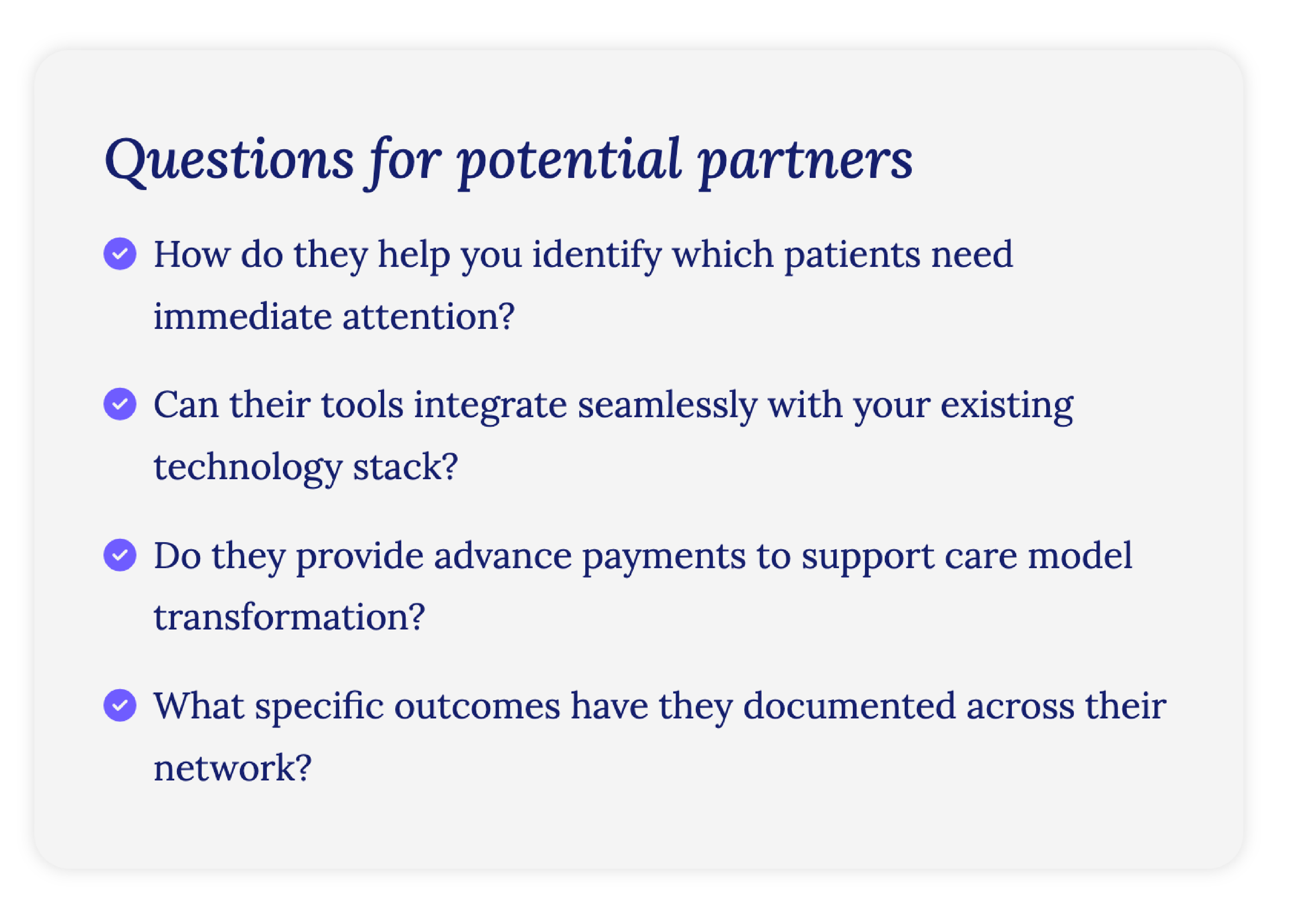
2. Performance Enablement: What capabilities drive measurable outcomes?
Technology and good intentions alone are insufficient. Success in value-based care requires systematically identifying which patients need attention when—and consistently acting on those insights.
Critical capabilities to evaluate:
Patient identification and prioritization:
- Machine learning algorithms that identify at-risk patients across preventive, acute, and predictive needs
- Integration capabilities that work within existing EHR workflows
- Real-time performance tracking with visibility into quality measures and financial projections
Financial alignment mechanisms:
- Advance payment structures that enable investment in preventative care models
- Value-based payment approaches that reward proactive care based on leading indicators
- Performance incentives aligned with actions that drive better patient outcomes
Measurable impact: Organizations that implement comprehensive performance enablement platforms typically see documented improvements in both patient outcomes and total medical expenditure reduction, with year-over-year performance trajectories showing consistent improvement.
Together, we will advance an innovative, tech-enabled approach to coordinating care for Medicare patients across Hawaii, carried forward by people who are embedded in the communities they serve.

3. Operational Readiness: Do you have the infrastructure for sustainable success?
Many primary care and ACO leaders are discovering that running an ACO involves more complexity than initially anticipated. What may have seemed like a straightforward path to value-based care has revealed layers of regulatory, operational, and financial challenges that require specialized expertise and significant resources.
Common operational challenges:
- Ongoing losses with no clear path to shared savings
- Difficulty meeting CMS requirements at current scale
- Resource strain from managing infrastructure independently
- Strategic questions about optimal organizational structure
Critical capabilities for sustainable ACO operations:
- Risk management: Sophisticated approaches to VBC participation across multiple models and risk tracks
- Performance attribution: Systems that tie payments directly to specific actions and outcomes
- Technology integration: Tools that enhance rather than disrupt existing workflows
- Risk mitigation: Downside protection through stop-loss and reinsurance options
Evaluating your path forward: The key question isn't whether to participate in value-based care, but how to structure that participation for sustainable success:
- Build internally: Requires significant capital investment, regulatory expertise, and operational infrastructure—suitable for large, well-capitalized organizations
- Partner strategically: Leverage external expertise while maintaining clinical autonomy—ideal for organizations wanting to focus resources on patient care
- Transition completely: Full operational handoff to proven ACO operators—appropriate for organizations seeking immediate risk mitigation and operational relief
As we look to the next decade of innovating and improving healthcare, I am thrilled to partner with Pearl to equip providers in our network with cutting-edge technology and data insights that will enable better patient care.

Your Critical Timeline: August 1st vs. September 8th
Organizations have limited time to evaluate options, conduct due diligence, and negotiate arrangements that align with their goals. Understanding these deadlines is crucial for your planning:
August 1st — Preliminary Submission Deadline:
- Express interest in potential ACO partnerships with CMS
- Submit TIN or NPI rosters (non-obligatory approval)
- Can work with multiple ACOs to preserve options
September 8th — Final Decision Deadline:
- Complete all contracting and operational considerations
- Make final ACO partner selection for PY 2026
- Last opportunity to withdraw if changing direction
What's your revenue optimization potential?
Pearl Health offers confidential assessments to help organizations evaluate their options before the deadlines. Connect with our team to explore how Pearl might support your strategic decisions.
See how strategic risk optimization could impact your organization's revenue potential. Our team provides confidential assessments based on your specific practice characteristics and patient panel.

Pearl Health is powering the future of healthcare
We’re a team of physicians, technologists, and risk-bearing experts with a passion for enabling our partners to deliver better care and reduce health system costs. Want to learn more?