
If you’ve spent any time with Alana Levy—whether discussing training for the Olympic Trials, product strategy, or the future healthcare—one thing becomes clear: she brings a unique combination of discipline, curiosity, and long-term thinking to everything she does. She has a steady, quietly persistent drive that shows up in both her work and her training.
As Director of Product at Pearl Health, Alana has helped guide the Pearl Platform from its earliest, bare-bones foundation into a robust, multi-program application used by increasingly complex healthcare organizations and care teams across the country. Her approach blends structured thinking with a deep empathy for end users, and a product philosophy rooted in action and a clear understanding of the healthcare system’s challenges.
We sat down with Alana to talk about long-term vision, the practical challenges of building for healthcare, and the mindset that connects marathon training with product leadership.
You recently qualified for the Olympic Trials in the Chicago marathon. How did that take shape?
I've been running since I was a kid and competed in high school and college as an athlete on Cornell’s Track and Field and Cross Country teams. After college, I didn’t see a place for myself in the pro running world so I shifted my focus from intense training to that of a casual athlete while beginning my professional career in tech. In 2020, like many others stuck at home during the pandemic, I started to spend more time doing the things I loved. For me, that meant running. I began to increase my mileage and started seeing real improvement. I was also part of a running club and was surrounded by a really inspiring group of women. And, when you’re training with people trying to achieve big goals, you start to quietly ask if you can do that too.
By 2022, I started thinking that hitting the Olympic Trials standard might be within reach if I really worked for it. I began working with a coach, started training in a really structured way, and my times dropped. I ended up running a 2:59 in NYC in 2022, then a 2:48 in Berlin and a 2:40 at CIM in California in 2023, and then a 2:42 in New York in 2024.
Last month, I ran a 2:36 in Chicago, which qualified me for the US Olympic Team Trials in 2028. It was the culmination of years of work and one of the most gratifying experiences of my life.
In terms of the actual training, I’ve really built up over the course of several years. For the past several years, I’ve averaged around 60-80 miles per week, peaking at 95 miles per week in the months leading up to Chicago. Every week included a long run, multiple doubles throughout the week, a tempo run, and track intervals. It’s a lot of early alarms and a “no days off” mentality. But it’s something I really love to do.

How does that training mindset apply to your work at Pearl?
In product, you're always working toward a goal that isn't going to happen overnight. You have a long-term vision, and then you have to show up every day and chip away at it. Some days the work feels incremental, but it adds up. I love looking back and seeing how far we’ve come.
It’s a lot like running. You need discipline, and you need to be okay with progress over perfection. You also have to be okay adjusting your approach and trying again if things don’t go as planned.
What does Pearl's mission mean to you?
To me, Pearl is about making value-based care accessible for primary care providers and helping them deliver patient-centered, high-quality care.
Our job in Product is to give practices tools that support that: by surfacing the right information, simplifying decision-making, and helping them care for patients without drowning in administrative burden.
When I talk to a care manager who tells me our tool saved them three hours this week, that's three hours they spent with patients instead of clicking through portals. That's what gets me up in the morning (outside of running).
Can you walk us through how the Pearl Platform has evolved since you joined?
When I started, we didn’t have a product. We didn’t have a login page, a way to make capitation payments, or any data flowing through the system. We were a few months from launching to our first set of customers in early 2022 and needed to build those foundational capabilities from scratch. From there, we started ingesting claims data, building the first patient insights engine and visualization tools, and slowly maturing into more advanced workflows.
Now the platform supports ACO REACH, MSSP, and MA programs, and we’re building for increasingly complex organizations with nuanced operational needs. It's been amazing to see how much our thinking and tools have matured. We went from “can we present data on a screen?” to “how do we intelligently surface the most critical insights for a specific user at the right moment?”
What does your team focus on?
I lead the Web Application Team. Everything users see and interact with in our platform, we build. We spend a lot of time doing research with practices to understand how work actually gets done—not just inside Pearl, but across their entire ecosystem of tools. You'd be surprised how many sophisticated practices are still managing their patient populations with spreadsheets, sticky notes, and printouts. That's not because they're behind the times—it's because existing healthcare technology hasn't met them where they are.
Designing for healthcare means understanding that context and building experiences that genuinely make their work easier—not just giving them another tool and another tab to switch between.
What do you learn from working so closely with customers?
Humility. You can think something is brilliantly intuitive, ship it with confidence, then watch users hate it, or worse, not use it. Maybe they're already doing it elsewhere, or it’s not their role to complete that task. Maybe the workflow you designed makes perfect sense on paper but completely falls apart in a real clinic. That’s why we do so much rigorous user research and user testing. We build something, we test it, users react, and then we go back and revise. It's always an iterative process.
What about building for larger practices—what are the challenges there?
Every large practice operates differently. One has three vendors for the same thing, another has none. One centralizes everything, another distributes across teams. You can’t build a one-size fits-all solution and expect it to work.
So we build modularly, flexibly, and with the understanding that we might need to change something down the road. We avoid making irreversible decisions wherever possible so that if we learn something new, we can adapt without having to tear everything down and start over.
What role does AI play in the product roadmap?
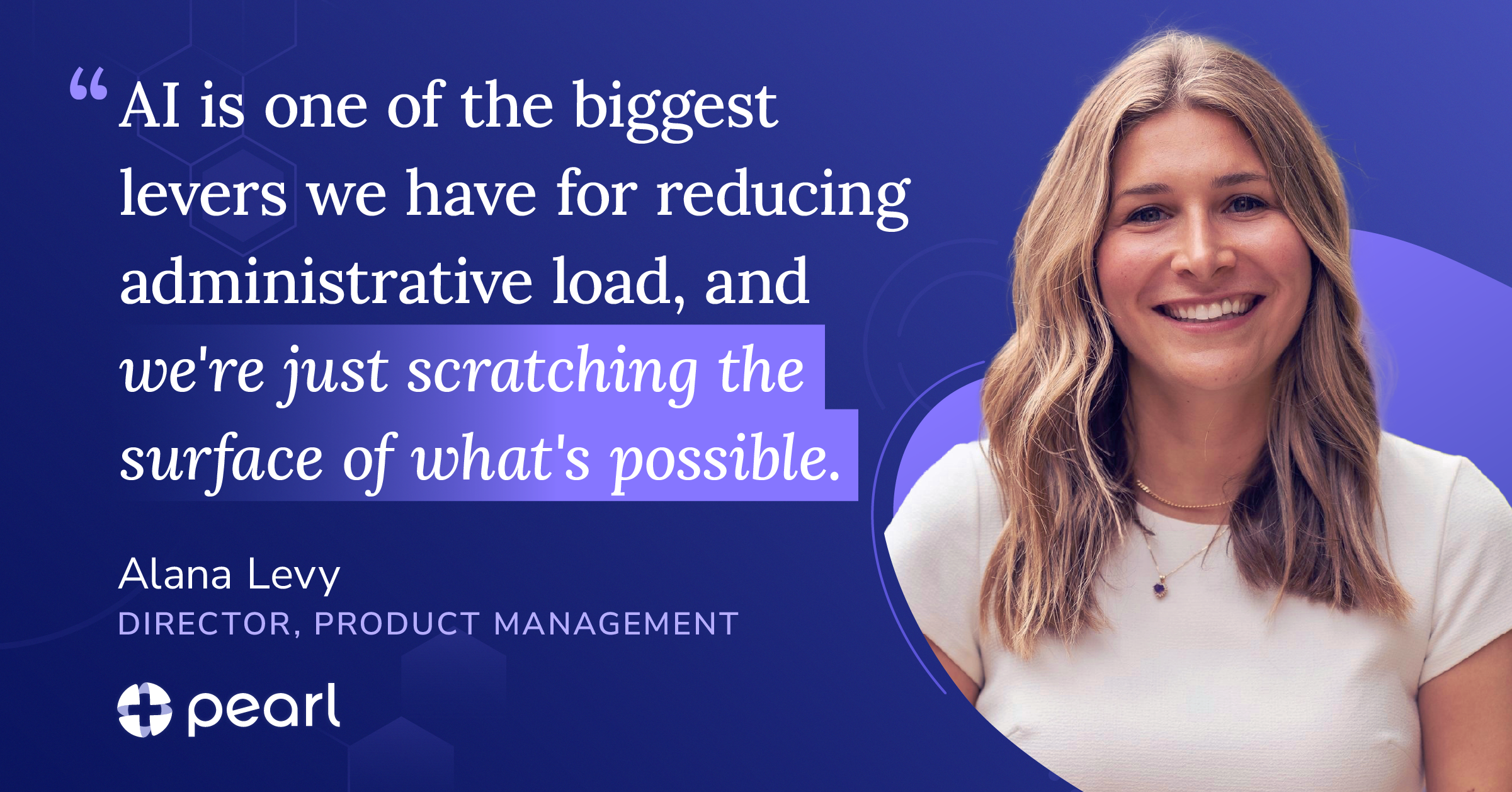
AI is one of the biggest levers we have for reducing administrative load, and I think we're just scratching the surface of what's possible.
We’ve already rolled out summarization tools for care managers that cut prep time dramatically. What really excites me is agentic tooling—systems that don’t just summarize information, but actually act on it. Imagine AI navigating the EHR, triggering follow-ups, improving coding accuracy, and bridging gaps between disconnected systems. There’s so much we can do with AI to help clinicians spend less time on their computer and more time with patients.
We anchor everything on patient-centric, outcome-driven design. We’re not building digital to-do lists or check-the-box workflows.
What sets Pearl's product philosophy apart?
We anchor everything on patient-centric, outcome-driven design. We’re not building digital to-do lists or check-the-box workflows. We want to deliver the right insights in the right moment to drive meaningful action, without burning out staff in the process.
We also care deeply about patients. When we design a feature or surface an alert, we think of it as a person, not a risk score or an optimization target. If a feature doesn’t meaningfully reduce administrative burden or improve a patient outcome, it’s not a priority.
How do you stay energized through tough training—or tough product work?
I know it sounds cliché, but running actually gives me energy. By the end of my morning run I genuinely feel ready to take on the day.
I also get energy from progress and momentum—in training and in work. Feeling like I’m moving toward something, even incrementally, keeps me going.
That mindset really helps in Product, too. I try to reframe problems as opportunities. If something is hard, I ask myself: how cool will it be when we solve this? What will we learn along the way? You have to believe that long, consistent work will pay off—and put yourself in the position every single day to make progress against that vision.
What kind of team culture do you value?
Collaboration mixed with honest debate. We come from different backgrounds—engineering, design, clinical, operations—and the product gets better when those perspectives collide. The best ideas rarely show up fully formed; they arrive as drafts that we refine together.
We also prototype early so we’re reacting to something real, not debating in the abstract, making collaboration much richer. Everyone can contribute to the solution, not just critique it.
What excites you most about what’s ahead?
The potential for agentic AI to actually make a clinician’s life better—not just by making things faster—but by fundamentally changing what their day looks like. Right now, doctors spend hours navigating EHRs, hunting for information across systems, and writing notes. What excites me is building systems that can do that work for them—so they can spend their time on the things that actually require human judgment and connection with patients.
We're also just starting to crack the code on multi-program, all-payer workflows. Most practices are juggling REACH, MSSP, MA—each with different requirements, different data sources, different everything. If we can build tools that intelligently handle that complexity in the background, that's a huge unlock.
We have a real opportunity to accelerate that shift and build tools that have tangible patient impact.
What kind of music gets you into the zone for a race or a product launch?
This is embarrassing, but I listen to a lot of 2000s hip-hop to hype myself up before a race or a hard workout. Not before a product launch though. I think the mood is a little different. A launch is more like a fun vibe—something upbeat, exciting, probably poppy. I don’t need to put Taylor Swift on record, but there it is.
As Pearl continues to grow, Alana’s work helps ensure that the Pearl Platform scales with clarity, empathy, and momentum—always grounded in what matters most: delivering real value to providers and better outcomes for patients. From empowering small practices to enabling complex health systems, her leadership is helping build a future where healthcare works smarter, faster, and more human.

Pearl Health is powering the future of healthcare
We’re a team of physicians, technologists, and risk-bearing experts with a passion for enabling our partners to deliver better care and reduce health system costs. Want to learn more?
