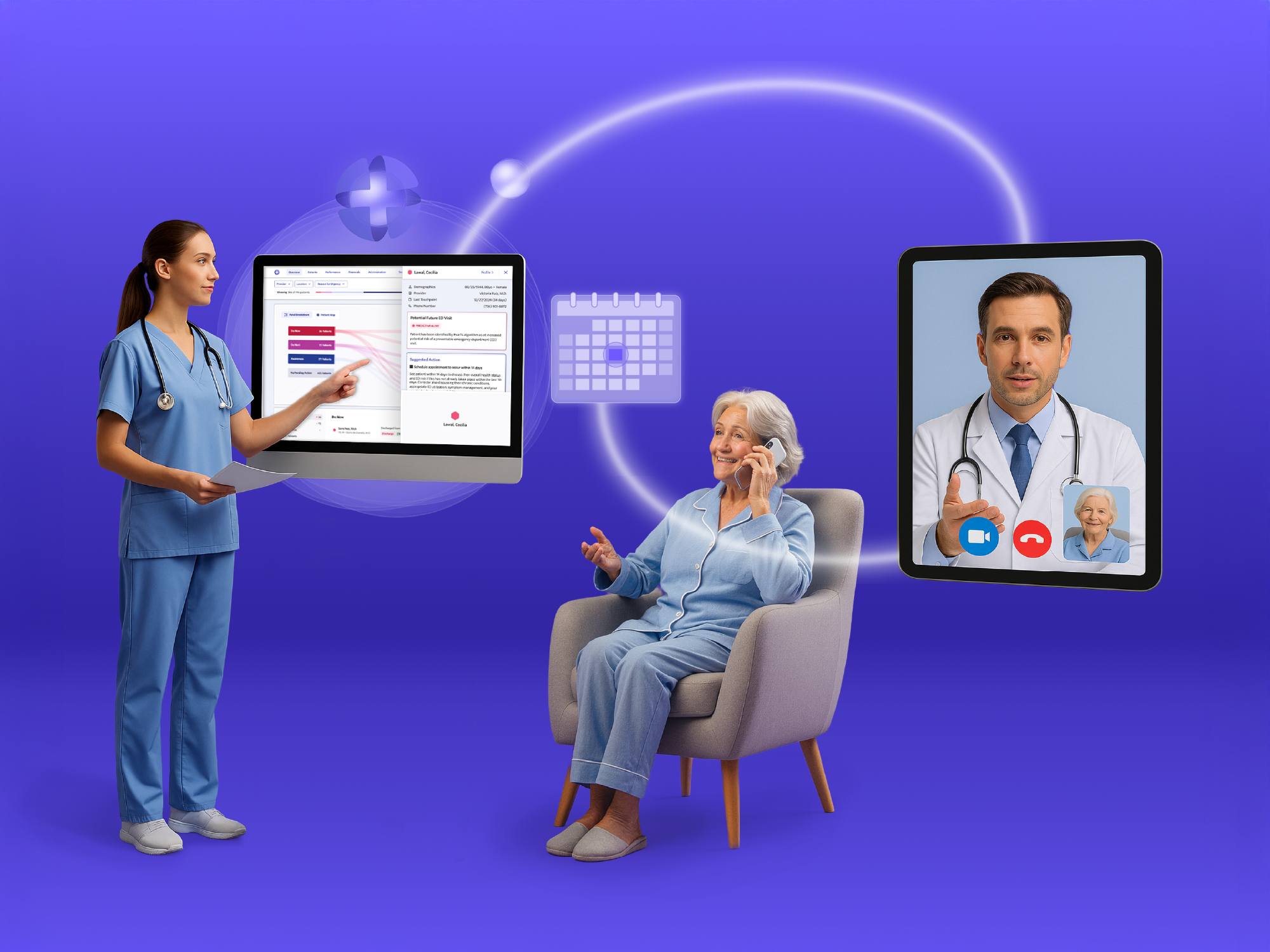
Automation in healthcare is evolving rapidly—from simple rule-based workflows to intelligent systems powered by artificial intelligence. This post explores what automation truly means in healthcare settings, how to implement it effectively, and where it’s headed as AI transforms static processes into dynamic, predictive systems. Our future is adapting workflows in real-time, and autonomously coordinating care at scale. Whether you’re a clinician, operator, or technology leader, understanding this trajectory from traditional automation to AI-powered intelligence is essential for building healthcare systems that deliver abundant, proactive care.
What is Automation?
At its core, automation is the systematic transfer of tasks from human execution to machine execution. In academic terms, it is the orchestration of processes where technology assumes responsibility for routine or complex actions once carried out by people. The principle is not new. Industrial automation transformed manufacturing in the 20th century, but in healthcare, the opportunity is profound: automation frees clinicians and operators to focus on higher-order judgment and human connection while machines handle repetitive, rules-based, or data-heavy work. Solving this can lead to an abundance of care. Failure to do so will lead to real problems.
Scholars such as James Reason and Lisanne Bainbridge have noted both the “ironies of automation” (humans often must oversee what machines do) and the “hierarchy of automation” (ranging from information gathering to full autonomous action). Pearl Health embraces this continuum, recognizing that healthcare demands the right balance between human oversight and machine delegation. Regardless of that spectrum, automation will unlock tremendous care for our country and must be prioritized by healthcare professionals at all levels.
How Do You Do It?
Automation is not simply about installing new technology. It is a disciplined process of re-designing workflows. At Pearl, we think of automation in three steps:
1. Identify Candidates for Automation
Look for tasks that are high-volume, rules-driven, and repetitive (e.g., patient outreach, scheduling, transport) or cognitively complex but pattern-based (e.g., risk stratification, patient communications). Ask: “Does this add value through human judgment, or could technology handle this faster and more consistently?”
2. Design for Reliability and Transparency
Effective automation builds trust. We apply principles of human-in-the-loop systems, where clinicians can see, understand, and intervene in automated processes. Transparency ensures adoption and avoids the “black box” problem. Clinical leaders won’t tolerate automation that isn’t explicable or understandable through simple inquiry.
3. Measure and Iterate
Automation must improve measurable outcomes — for example, efficiency, accuracy, timeliness, or clinical impact. We continuously measure impact through rigorous data feedback loops, akin to Deming’s principles of quality improvement.
Examples at Pearl are as simple as monitoring HIEs (Health Information Exchanges) and notifying our practices about when one of their patients are discharged.
Another slightly more complicated version are our Do Now lists, which automatically surface the list of patients that need attention at any given moment, sorted by urgency, and with all the necessary context. If practices wanted to build a Do Now list on their own, without automation, they’d have to review their patients’ entire billing history, every month, and review 100% of HIE feeds in real time. There literally aren’t enough hours in the day to accomplish this without automation.
Applications in Healthcare
Healthcare is fertile ground for automation because of its administrative complexity and data intensity. Key applications include:
- Administrative Automation: Streamlining scheduling, regulatory compliance, payments.
- Clinical Automation: Risk prediction, medication adherence alerts, chronic disease management pathways.
- Operational Automation: Population-level outreach, care coordination, resource allocation.
The underlying principle is that automation should not just make things faster but should make care better and cheaper: fewer errors, more proactive interventions, and more time for human care at the right site of service by the right professionals. At Pearl we think of this as not allowing patients to fall through the cracks and this can be as simple as automatically detecting when a patient is due for their AWV, and suggesting a list of conditions to review during the visit or slightly more complicated by predicting when a patient will likely go to the hospital and supporting our clients to make contact and help them see a primary care provider to lower the risk of that admission event.
Future of Automation and Its Connection to AI
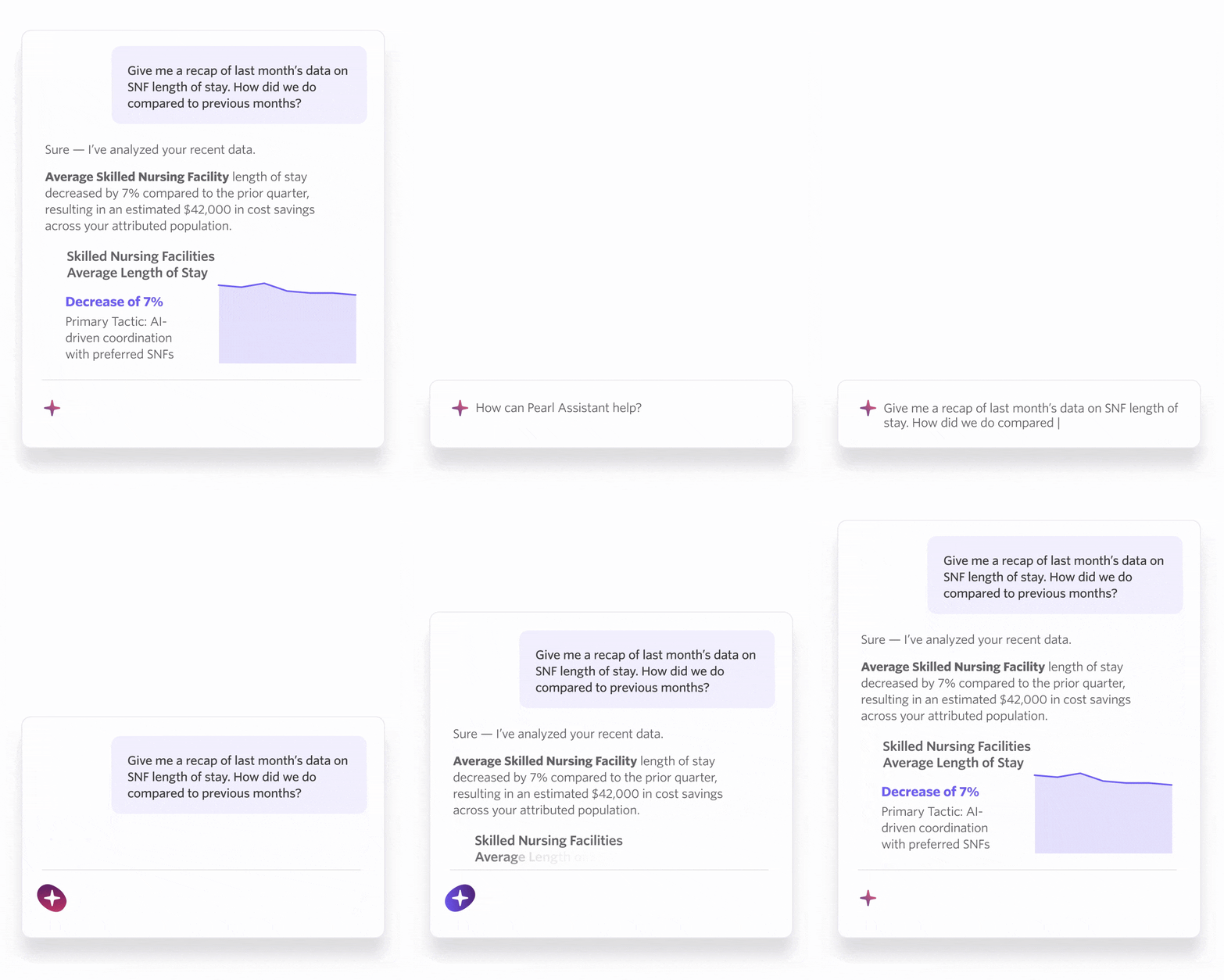
The future of automation in healthcare lies in its fusion with artificial intelligence (AI). Where traditional automation executes predefined rules, AI-powered automation adapts and learns from data.
- From Rules to Predictions: AI allows automation to move beyond “if-then” logic into probabilistic forecasting. Pearl is now anticipating which patients are at risk before events occur (hospital and ER avoidance).
- From Static to Dynamic: Instead of rigid workflows, AI-driven automation dynamically adjusts to each patient’s context and changing health status and allows for continuous learning of what leads to positive patient outcomes and effective methods for scaled outcomes based care.
- From Assistive to Autonomous: Over time, automation will transition from suggesting interventions to carrying them out (with human oversight), creating a truly intelligent healthcare operating system agentically powered.
For Pearl, this convergence of automation and AI is not just about efficiency, it is about clinical leadership at scale: getting patients the right care before disease and decline, with physicians supported by intelligent, proactive systems.
Our agents will automatically adapt their workflows, e.g. post-discharge, to match each health system’s unique processes and procedures. They’ll also identify opportunities for improving those processes, and surface them to the customer, supported by data that shows financial opportunity and patient outcome improvement potential.
Closing Thought
Automation is often misunderstood as a way to replace people. At Pearl, we see it differently: automation amplifies human capacity and improves access to care and improves its quality while reducing its costs. By stripping away friction, we allow clinicians and care teams to spend more time on empathy, creativity, and judgment: the things machines cannot replicate. In healthcare, automation is not about less humanity; it’s about creating more space for it.

Pearl Health is powering the future of healthcare
We’re a team of physicians, technologists, and risk-bearing experts with a passion for enabling our partners to deliver better care and reduce health system costs. Want to learn more?